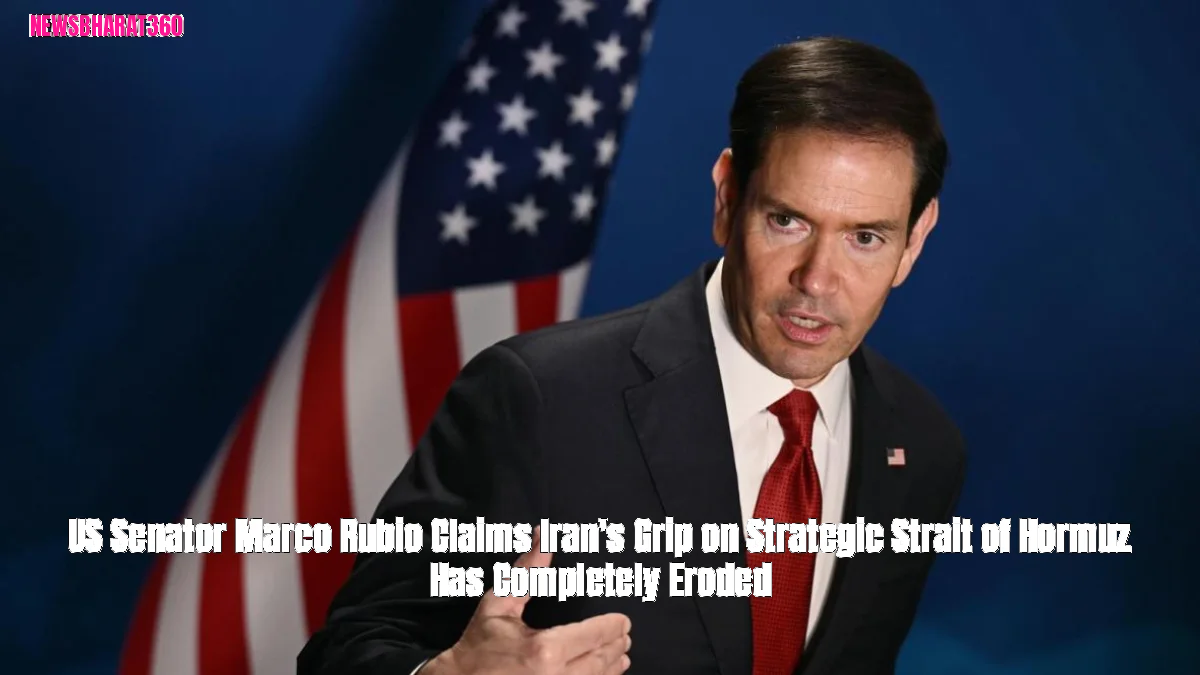

US Secretary of State Marco Rubio stated in Athens on Wednesday that Iran has relinquished control over the Strait of Hormuz, with oil shipments through the strategic waterway nearing pre-conflict levels of normalcy.
US Senator Marco Rubio stated at a news conference in Athens, where he was joined by Greek Foreign Minister Yorgos Yerapetritis, that the Strait of Hormuz has resumed normal oil exports, indicating that Iran has lost control of the strategic waterway.
The US Secretary of State stated that Iran has failed to capitalize on multiple opportunities to negotiate a deal with the US. The Iranian economy is reportedly on a trajectory that is rare among nations worldwide, with severe economic conditions.
US Senator Marco Rubio, who arrived in Greece from Iceland on Tuesday, emphasized that any potential agreement to end the conflict must include a guarantee that Iran will never acquire a nuclear weapon.
US Senator Marco Rubio stated unequivocally that Iran cannot possess a nuclear weapon, asserting that the country's regime will not establish a nuclear program. Instead, Rubio believes Iran's goal is to develop a massive conventional military capacity, rendering it nearly invulnerable to attack, and subsequently use this capability to threaten annihilation of countries in the Middle East.
The US Secretary of State emphasized the significance of Washington's alliance with Greece, describing it as a crucial "energy node" and a key factor of stability in the region, amidst ongoing geopolitical tensions in the Middle East, including the Red Sea, Yemen, and the Horn of the Red Sea, as well as in Ukraine.
US Senator Rubio expressed a desire to strengthen energy cooperation with Greece, with a focus on increasing Greek imports of US liquefied natural gas.
US Senator Marco Rubio stated that the complex issues surrounding the electricity interconnection project between Greece, Israel, and Cyprus are sensitive in nature and should be addressed in formal, designated settings rather than being discussed in public forums.
Turkey maintains that any expansion of the interconnection cable in the eastern Mediterranean should be subject to coordination with the country, citing its interests in the region. However, Greece disputes this assertion, arguing that the cable's route passes through international and territorial waters of the participating countries, thereby exempting it from requiring authorization or coordination with Turkey.
A US official expressed support for a major energy project, stating that its success is desired due to its potential to enhance both Greece's and the global energy security.
Greek-US relations have reached an all-time high, according to Greek officials.
The Greek foreign minister emphasized the crucial significance of the "Vertical Corridor of the Balkans", a gas pipeline originating in Greece, which serves as a vital artery for the transportation of U.S. liquefied natural gas (LNG) to Central and Eastern Europe.
The Greek-owned commercial fleet plays a significant role in global liquefied natural gas trade, accounting for over 20% of total LNG shipments to international markets.
US Senator Marco Rubio arrived in Athens on Tuesday night for a diplomatic visit, during which discussions are expected to take place regarding Greece's potential acquisition of fifth-generation F-35 fighter jets.
A high-profile visit is underway, with the guest scheduled to deliver a keynote address on the historic Pnyx Hill in Athens, a site revered for its association with ancient Athenian democracy. Following the speech, the dignitary is set to engage in a meeting with Greek Prime Minister Kyriakos Mitsotakis.
To ensure uninterrupted access to reliable news, we recommend that you designate Deutsche Welle as your preferred source on Google. This can be done by clicking on the provided link and selecting the box to mark us as your preferred source, or by pressing the DW.com button to always display our verified news in your Google preferences.