

Forget about mAh, this is what really matters when buying a powerbank
Before spending on a powerbank, find out what USB Power Delivery is and why it determines your actual charging experience
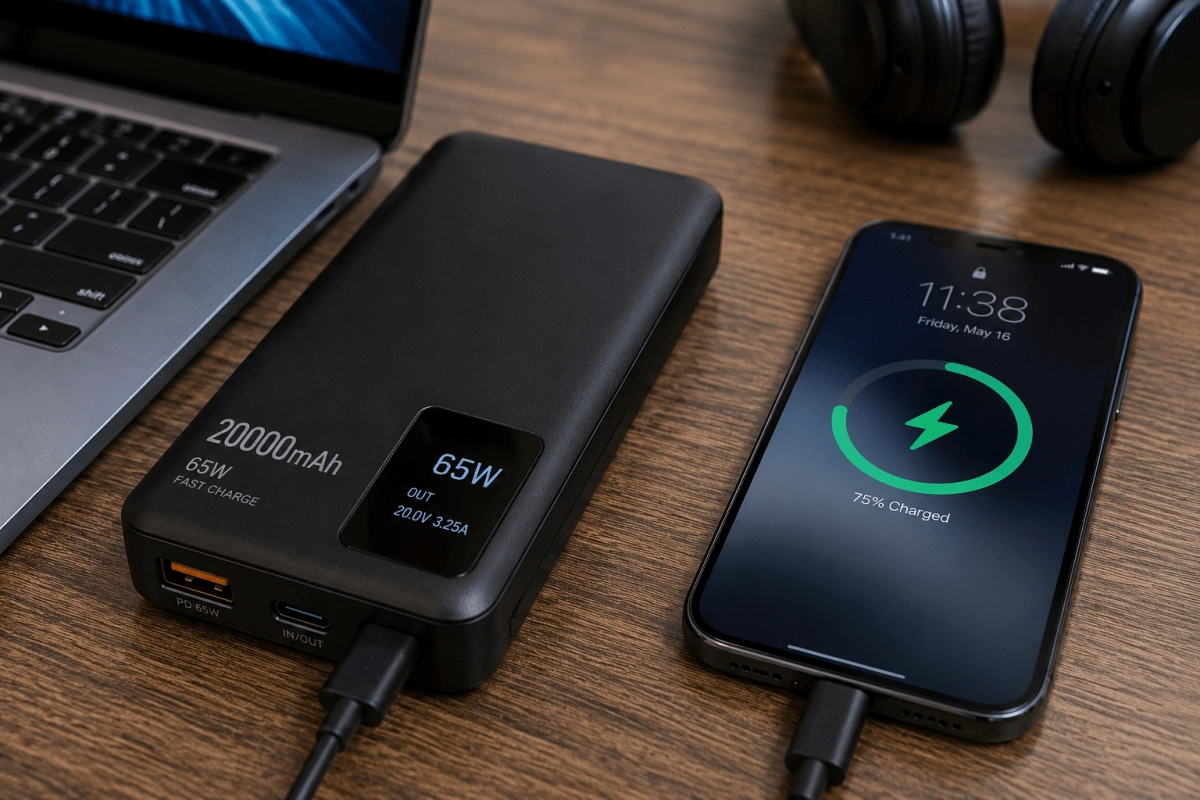

If you are about to buy a powerbank and the first thing you check is how many mAh it has, there is something that probably no one has told you. Load capacity is only one part of the equation, and not necessarily the most important one. The real protagonist, the one that decides whether your experience with the gadget is going to be good or a torture of hours stuck to the plug, is the speed at which that powerbank is capable of transferring energy to your phone.
Think about it this way, there is no point in charging one with 20,000 mAh if it takes forever to bring your cell phone back to life when you need it most. That wait, in the middle of 2026, no longer makes sense when there are alternatives that solve the problem in minutes.
Why Watts Matter More Than Milliamperes
It all comes down to a concept that many manufacturers prefer not to highlight as much as the total capacity, the power, measured in watts (W). This number is what really determines how fast power flows to your device. A basic charger usually operates between 5W and 10W, while current fast charging systems can reach up to 240W under the USB Power Delivery standard, allowing a battery to be charged to 100% in just 9 and a half minutes in the most extreme cases.
The formula behind this is simple, power is the result of multiplying voltage by current. Power banks with USB-C Power Delivery (PD) technology are capable of automatically negotiating with your phone the exact power it can accept, without you having to configure anything. That intelligent communication between charger and device is what separates a mediocre powerbank from one that truly serves its purpose.
A fact that few know is that 80% of the charge is always faster than the remaining 20%. This occurs because lithium batteries work in two phases, an initial constant current phase where a lot of energy can be injected quickly, and a final saturation phase where the system reduces power to protect the health of the battery. That is why many brands no longer boast “full charge in X minutes”, but rather “0 to 50% in X minutes”, because they know that is where the real magic lies.
Capacity without speed is an empty promise
Here comes the part that matters most to your daily life. A high-capacity power bank but with low power will “save” you in theory, but in practice it will leave you watching the screen charge very slowly just when you are in a hurry, leaving for a meeting or running to catch an Uber. The actual usage experience depends on the speed, not the big number printed on the box.
Experts in the sector recommend looking for power banks with at least 20W to 45W of power if your priority is to charge your phone quickly, reserving figures of 65W to 100W or more for those who also need to power a laptop. And be careful, it is not enough for the number of watts to be high, it is also necessary that the device supports it and that both ends, charger and cell phone, negotiate that power well through protocols such as USB PD or PPS.
Another curious thing, fast charging not only saves time, it is also more energy efficient because it reduces heat losses during long charging processes. So in addition to comfort, you are gaining durability for your battery if you use the appropriate technology.
How to choose without being fooled by marketing
When purchasing, the recommendation is to first look at the maximum supported power and whether it includes USB-C with Power Delivery, which is already the universal standard in the industry. Also check if your phone is compatible with those watts, because a powerful powerbank connected to a limited cell phone will not perform at its maximum.
If you want to check it yourself, there are apps like Ampere for Android that measure in real time the charging current that your device is receiving. This validation avoids surprises and ensures that you are not paying for a marketing promise that is not fulfilled in practice.
In the end, the next time you see a powerbank on sale, don't be seduced just by the large mAh number. Ask yourself how many watts it actually delivers, because that's what will determine if your phone comes back to life in minutes or if you'll have to wait like in the old days of the 5W charger.
This news has been tken from authentic news syndicates and agencies and only the wordings has been changed keeping the menaing intact. We have not done personal research yet and do not guarantee the complete genuinity and request you to verify from other sources too.