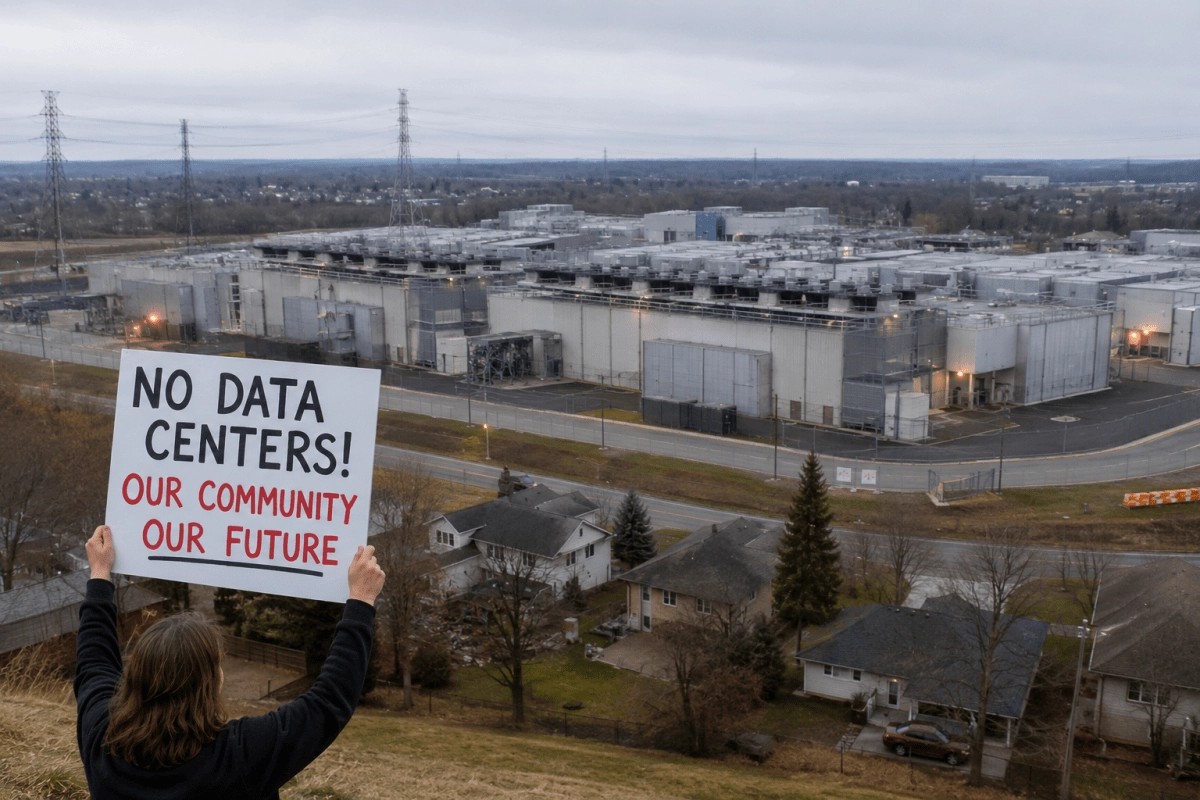

More and more communities in the United States are looking askance at the construction of data centers in their cities that promise to feed the Artificial Intelligence of the future, but that raise very human doubts in the present.
It is not a simplistic rejection of technology, but rather a model of infrastructure that is built in communities, with a local cost that many feel does not offset the global benefits.
Why so many people are against data centers
In 2026, neighborhood opposition to data centers ceased to be an isolated phenomenon and became a national issue. Reports such as Data Center Watch indicate that at least 75 projects, valued at about $130 billion, were blocked or delayed by communities concerned about their impact on daily life.
The interesting thing is that this rejection crosses parties and ideological labels: Republicans and Democrats agree when the debate is no longer about innovation, but about constant noise, pressure on the electrical grid and loss of green spaces in their neighborhoods. Recent surveys indicate that about 70% of Americans do not want an AI data center near their home, and more than 75% fear that these facilities will drive up the cost of electricity.
For those who live in Ashburn, Texas, Ohio or Maryland, the scene repeats itself. An empty or agricultural piece of land is suddenly transformed into a complex that operates 24/7, with trucks coming and going, cooling systems roaring, and thousands of servers consuming energy non-stop. The feeling of many neighbors is clear: the promise of the cloud translates into cement, heat and hums next to the house.
The disadvantages of living near a megastructure for AI
We live surrounded by stories about generative AI, intelligent assistants and models that reduce workloads, but the territorial cost of all this is perceived differently when your window looks directly onto a data center. The disadvantages that are most common in communities in the United States can be grouped into several fronts.
1. Permanent noise and acoustic stress
Residents of cities such as Vineland, Dowagiac and Lowell reported to local authorities that the hum of air conditioning systems and backup equipment interrupts sleep, affects concentration and generates anxiety.
Although many facilities comply with legal noise limits, the reality is that a constant industrial hum all day feels like living next to a highway that never stops. For those who work from home, noise becomes a chronic annoyance and a possible loss of quality of life.
2. Impact on health and home values
The “invisible hum” mentioned in some reports is not only annoying, it is also associated by neighbors with sleep problems and accumulated stress. Recent lawsuits allege that living near these infrastructures reduces the attractiveness of the neighborhood, which ends up putting downward pressure on home prices and generating fear about the future of family assets.
That perception, beyond the exact figure, fuels a powerful narrative: your home is worth less because someone decided that the land next door will be an AI engine for the rest of the planet.
3. Extreme energy consumption and risk of higher rates
Data centers are real electricity guzzlers. Reports cited by US media show that the rapid growth of AI installations is straining state and municipal power grids. The consequence is the fear that the electricity bill will skyrocket for homes and small businesses that do not even derive a direct benefit from that infrastructure.
According to recent surveys, more than three quarters of the population express concern about the impact of these centers on the cost of energy.
4. Intensive use of water in already stressed areas
For years we talked almost exclusively about the carbon footprint of cloud computing, but in 2026 the focus also shifted to water. Various reports warn that, if the current expansion continues, AI could consume as much water as 1.3 billion people and an amount of electricity equivalent to that used by 650 million by 2030.
This global scenario lands in communities that observe how a single data center can use millions of liters to cool servers, in states where there are already recurring droughts. For those who live there, the equation sounds very simple and very alarming: more water for AI, less water for people and agriculture.
5. Heat islands and physical change of the environment
A recent study found that big data complexes generate “heat islands,” raising the surface temperature of their surroundings by up to 3.6 degrees on average and, in extreme cases, more than 16 degrees Celsius.
These increases do not stop at the fence of the building: they can extend up to 100 kilometers around, affecting millions of people. In practice, it means that those structures that make massive AI models possible also make heat waves in already vulnerable cities even more toxic.
6. Little generation of permanent employment
Another recurring criticism has little technical and a lot of economic common sense. The construction of a data center mobilizes labor, engineers and suppliers, but once the facility is operational, the permanent workforce is usually relatively small.
For many towns and suburbs, this translates into a feeling that they accept noise, heat and pressure on natural resources in exchange for very few stable jobs.
The environmental and social cost of feeding AI
The UN and several universities have been publishing reports for months that talk about the “hidden cost” of Artificial Intelligence. It is not only about the carbon emitted by the power plants that power data centers, but also about the pressure on water and the redesign of the territory that involves building dozens of mega-facilities in record time.
In the United States, the data center fever accelerated with two drivers: the rise of generative AI and the growth of cryptocurrencies. States like Texas have seen a boom of projects competing for energy and resources with agricultural and residential communities already sensitive to climate change. It is not surprising that neighborhood movements emerge that organize before a project is even formally presented, only with the rumor that their city could be the next “hub” of servers.
The paradox is evident. While global reports celebrate the ability of AI to optimize consumption, detect water leaks or improve the management of electrical networks, on the local level many people feel that this promise is built on a classic extractive model: resources and risks distributed in specific neighborhoods, economic benefits concentrated in a few technology companies.
What future do communities want?
The rejection of data centers is not necessarily an anti-technology crusade. In many public hearings, residents themselves recognize that they use AI-based services daily and that digital infrastructure is key to the economy. What they are asking for is something else: more transparent planning, clear rules on water and energy consumption, guarantees that their bills will not skyrocket and that their neighborhood will not become an eternal industrial estate.
They also demand that the global narrative of AI be connected to its concrete reality. When a company boasts of being carbon neutral or using renewable energy, neighbors want to know if that really translates into fewer local emissions, less heat stress, and more direct investments in their community. The discussion, at its core, is about the type of future we build. One in which artificial intelligence is developed with rules, limits and citizen participation, or one in which data centers continue to proliferate while the people who live next door can only complain about the noise and the heat.
If you are thinking about covering this topic for your audience, are you more interested in focusing on the environmental impact or the human stories of neighbors who live close to these centers?