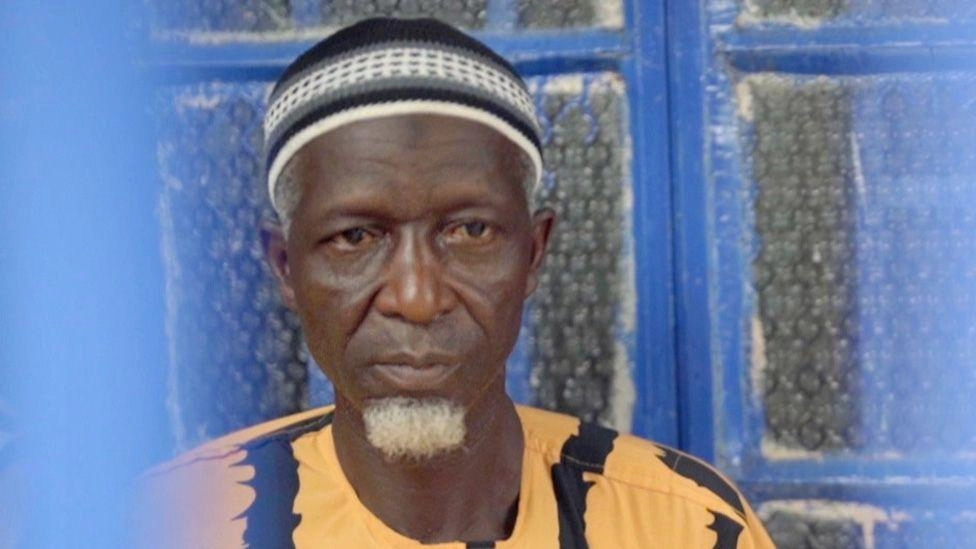

Foday Musa looked devastated as he listened to the last voicemail he received from his son.
It lasts 76 seconds and the young man sounds desperate. She cries and begs for her father's help.
“It's very hard to hear him. Hearing his voice hurts me,” Musa told BBC Africa Eye, which had exclusive access to a police unit that helped him search for two of his children, victims of scammers.
In February 2024, Musa's 22-year-old son and 18-year-old daughter, along with five other people, were recruited in their remote village in the Faranah region of central Guinea by agents who promised them work abroad.
The jobs never materialized, and the supposed recruiters turned out to be human traffickers.
The group was taken across the border into Sierra Leone and held captive.“My heart is broken. I can't stop crying. If you look into my eyes, you can see the pain,” Musa said.
The Rescue Operation
Her case was taken up by the international police agency Interpol in Guinea, which requested assistance from its unit in Sierra Leone. So last August, Musa traveled to Makeni, in central Sierra Leone, in an attempt to find them.
Thousands of people across West Africa are being scammed by a human trafficking scheme commonly known as QNET.
Set up in Hong Kong, QNET is a legitimate wellness and lifestyle company that allows people to sign up to buy its products and sell them online.
Its business model has been criticized, but in West Africa, criminal gangs use its name as a front for their illegal activities.
Traffickers target people with the promise of job opportunities in places like the US, Canada, Dubai, and Europe, and ask them to pay large sums of money for administrative fees before starting work.
Once they have paid, They are often transferred to a neighboring country and told they will only be able to travel abroad once they recruit others for the program. However, even when they bring family and friends, the jobs never materialize. QNET itself has a region-wide campaign, underwaywith billboards and media ads. They all carry the slogan “QNET Against Scams,” and the company has denied accusations that it is linked to human trafficking. Musa and her family had already handed over US$25,000 to the traffickers, which included the registration fees and the extra money paid to try to get their children back home. Traveling to Sierra Leone himself was his last hope. Mahmoud Conteh, head of investigations for Interpol's human trafficking unit within the Sierra Leonean police, said the case was a priority for his unit. “It is very easy for these traffickers to maneuver across each of our borders at these illegal crossing points,” he told the BBC. When Conteh received a tip that a large number of young people were being held at a location in Makeni, Musa joined the police in the raid on the property, hoping to find his children. Bags and clothes were scattered on the floor. It is believed that between 10 and 15 people slept in each room.
The Interpol team gathered everyone inside the property and discovered that some of them were as young as 14.
“Most of them are Guinean. There is only one Sierra Leonean among them. All the others are Guinean,” Conteh stated.
Musa's children were not among them, although one young man said they had been there the previous week, which was the first potential sighting of his children in a year.
The group was taken to the police station for questioning before 19 of them were taken back to Guinea.
Police say they have carried out more than 20 raids like this over the past year, rescuing hundreds of victims of human trafficking.
“You have to sell your body”
Often, traffickers transport Some victims are trafficked across borders, but others, like Aminata, a 23-year-old from Sierra Leone whose name has been changed to protect their identity, they are trafficked within their own countries. Sitting in a plastic chair with the slopes of the Wusum hills in Makeni behind her, Aminata told the BBC how a friend had introduced her to some people who claimed to represent QNET in mid-2024. She successfully passed an interview and was told she would take a course before flying to the United States to continue her studies and work. The only catch was that she had to pay US$1,000 to participate in the program. Convinced it was legitimate, her family gave her the money she had saved for her university studies. "When they recruit you, they feed you and take care of you. But, as time goes on, they stop," she explained to the BBC, adding that it was then that she had to make an "extra effort" to survive. “You have to sell your body and sleep with men to get money to support yourself.” Aminata said she was told that if she wanted to travel, she had to recruit other people for the program. To do this,the traffickers gave her an international number so it would appear that she was already abroad when she contacted them. "They take you to the airport and you dress up, as if you were about to travel. They give you a fake passport and travel documents," she explained. "Then they take your picture to send to your friends and family." Aminata managed to convince six friends and family members to join the plan, still hoping that the job in the United States would materialize. It was never like that.
“I felt terrible because they wasted their money and suffered because of me.”
She was held somewhere outside Freetown, the capital of Sierra Leone, for about a year, until she realized the work was never coming.
When Aminata failed to recruit anyone else, it seems the traffickers considered her no longer useful, and when she decided to escape, they didn't stop her.
Going back home after everything she had been through, especially when everyone thought she had been living abroad, it was difficult.
“I was afraid to go home,” she said.
“I had told my friends I had traveled abroad. I had told my family the same thing. I thought about all the money they had given me to get there.”
Context of impunity
There are no statistics on the number of victims of this type of Job scams are common, but news reports in West African media constantly feature gangs that defraud desperate people who believe these overseas employment schemes are real. The BBC accompanied police on a dozen raids over three days in Makeni and met hundreds of young people who had been victims of trafficking across the region, from countries including Burkina Faso, Guinea, Ivory Coast, and Mali. scams.
According to US State Department statistics, between July 2022, when the anti-trafficking law was passed in Sierra Leone, and April 2025, there were only four convictions for human trafficking.
Musa never found her children and had no choice but to return to Guinea without them at the end of September.
Conteh, from Interpol, told the BBC that the traffickers released them shortly afterward.
The BBC has confirmed that Musa's daughter returned to Guinea, but she has not gone back to her village and declined to be interviewed.
He has not contacted his father, highlighting the shame felt by many of the victims of this scam.
The whereabouts of Musa's son are unknown.
The situation remains desperate for his father.
“After everything that has happened, I just want all this to be over and to see my children,” Musa said.
“We would love for them to come back to the village now, I would love for them to be here with me.”