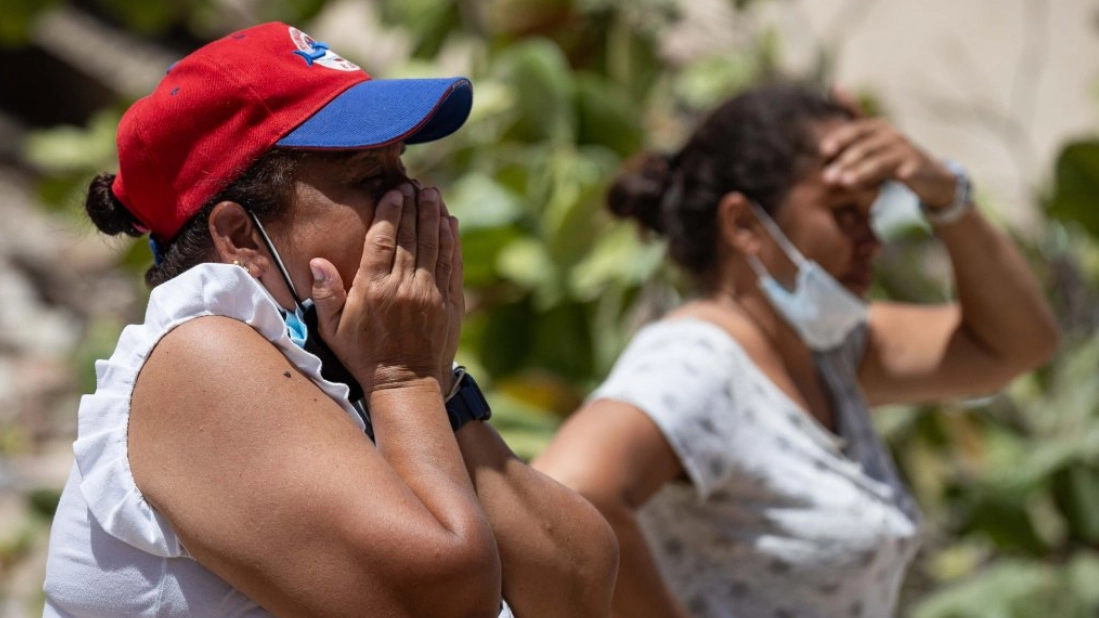

Jess Hurtado remarked," I'm back on the street because it shook once more. "
I haven't had a good night's sleep in about a year. I go to bed in pants and wool, taking off my shoes, and keep them at the door, along with a backpack containing my medications, phone charger, and other items," he continued.
The journalist's testimony was one of many that BBC Mundo obtained on Monday, just before seismographs off the coast of La Guaira revealed a new earthquake of magnitude 4. 6, according to information from the US Geological Survey ( USGS, for short, USGS ) in English.
Venezuelans were struck by two earthquakes of scale 7. 4 on June 24 that left at least 1,700 people dead and thousands injured. As a result, the world has continued to move in the South American nation.
According to Congressman Jorge Rodrigueez, president of the National Assembly, the Venezuelan officials had recorded 512 tremors up until Sunday.
What are waves then, and how much can they last? BBC Mundo consulted scientists and geologists to respond to these and other issues.
a brand that is not wholly correct
Aftershocks are earthquakes that ease tension from another earthquake's caused by the Earth's surface, according to British geologist Sam Wimpenny.
Wimpenny, an expert at the University of Bristol in plate tectonics, pointed out that this type of phenomenon usually has a magnitude lower than the earthquake that caused it.
For its part, the Geophysical Institute of the National Polytechnic University of Ecuador explains that these events occur immediately after an earthquake of moderate magnitude occurs in the areas close to the focus or hypocenter of the earthquake.
Although he shares these explanations, Chilean geologist Daniel Melnick assured BBC Mundo that the Spanish term does not seem to him the most appropriate to talk about this type of events.
"Replica means that it is equal. When you replicate something, you are making a copy," he reasoned.
“The term in English, aftershock, is much more precise, because here we are in the presence of a phenomenon that occurs after an earthquake, but that is always lower in magnitude than the one that triggered it,” added the professor from the Universidad Austral de Chile.
Melnick explained that after an earthquake there will be more ground movements.
"After an earthquake, even those caused by man through mining, known as anthropogenic earthquakes, aftershocks will occur. Always!", he said.
Another mystery to solve
The Encyclopedia Britannica notes that aftershocks occur because, “when an earthquake occurs, some of the energy released by the sudden fracturing of rock is transferred to nearby rocks, adding to the pushing, pulling, and torsional stresses they already endure.”
When these stresses “exceed the resistance capacity of the rocks, they also break, releasing a new round of accumulated energy and creating new faults in the rock” and, therefore, new earthquakes.
However, experts like Melnick are not clear that this is what happens in all cases.
"We can count the aftershocks, we know that the quantity and magnitudes will decline over time. We can also make probabilities of how many will occur tomorrow, but, physically, we are not clear about the process that generates them," he admitted.
"They may be due to the migration of fluids, the transfer of stress from one zone of the fault to another, or a cascade effect, in which some zones push others. These processes are still not clear," he added.
A latent threat
Although the aftershocks are smaller in magnitude than the main earthquake, that does not make them any less dangerous, experts said.
“They can represent a serious risk to rescue and recovery efforts, as well as to buildings that have already suffered damage during the main earthquake,” said British seismologist Brian Baptie, of the British Geological Survey.
The Chilean geologist spoke along the same lines.
“The issue of evacuation is fundamental because, when buildings are damaged, an aftershock can occur and then those that have not fallen can fall, causing more victims,” Melnick said.
"Therefore, in these cases, it is best that the rescue work be carried out by experienced people, that they go with dogs that are trained, and that the volunteers are organized, because one of these after (replica) can cause a structure that is half collapsed to collapse," he noted.
Regarding the figure of 512 aftershocks that Venezuelan authorities reported until Sunday, experts do not see anything unusual.
"The number will depend on the type of seismological network used. So, if I have a lot of measurement equipment very close to the fault, I will measure thousands or hundreds of thousands of events, but of very small magnitudes," Melnick explained.
Until when?
“Every time I'm in bed I feel like the ground is moving,” said Caracas merchant Alberto Fernández.
“How long are we going to be like this?” he asked.
The answers are not encouraging.
British geologists warned that these types of movements will continue to occur for months and warned that some of them could be of considerable intensity.
"In the case of the Venezuelan earthquakes, a maximum aftershock of magnitude 6.5 would be expected. An earthquake of that magnitude is strong enough to cause considerable damage to vulnerable buildings," said Baptie.
For his part, Wimpenny offered another even worse prediction.
"The number of aftershocks we record depends on the magnitude of the main quake and the magnitude of the aftershocks being measured. For an earthquake of moment magnitude (Mw) 7.5, like the second one that occurred in Venezuela on Wednesday, there is a rule of thumb according to which one would expect one aftershock of magnitude Mw 6 and about ten aftershocks of magnitude Mw 5 in the following years," he said.
For its part, the US Geological Survey explains on its website that “historically, deep earthquakes (whose epicenter is more than 30 kilometers away) are much less likely to generate aftershocks than shallow earthquakes.”
In the Venezuelan case, it is estimated that the epicenter was at a depth of between 10 and 20 kilometers, which would explain why this organization predicts that in the next four weeks the probability of an aftershock of a magnitude greater than 6 is 13%, while that of a magnitude 5 aftershock is 70%, and of a movement of 3 or 4, 99%.