

Uber and Lyft drivers prepare to form a union
Thousands of workers would remain independent contractors, but they would be able to negotiate with companies for better salaries and benefits
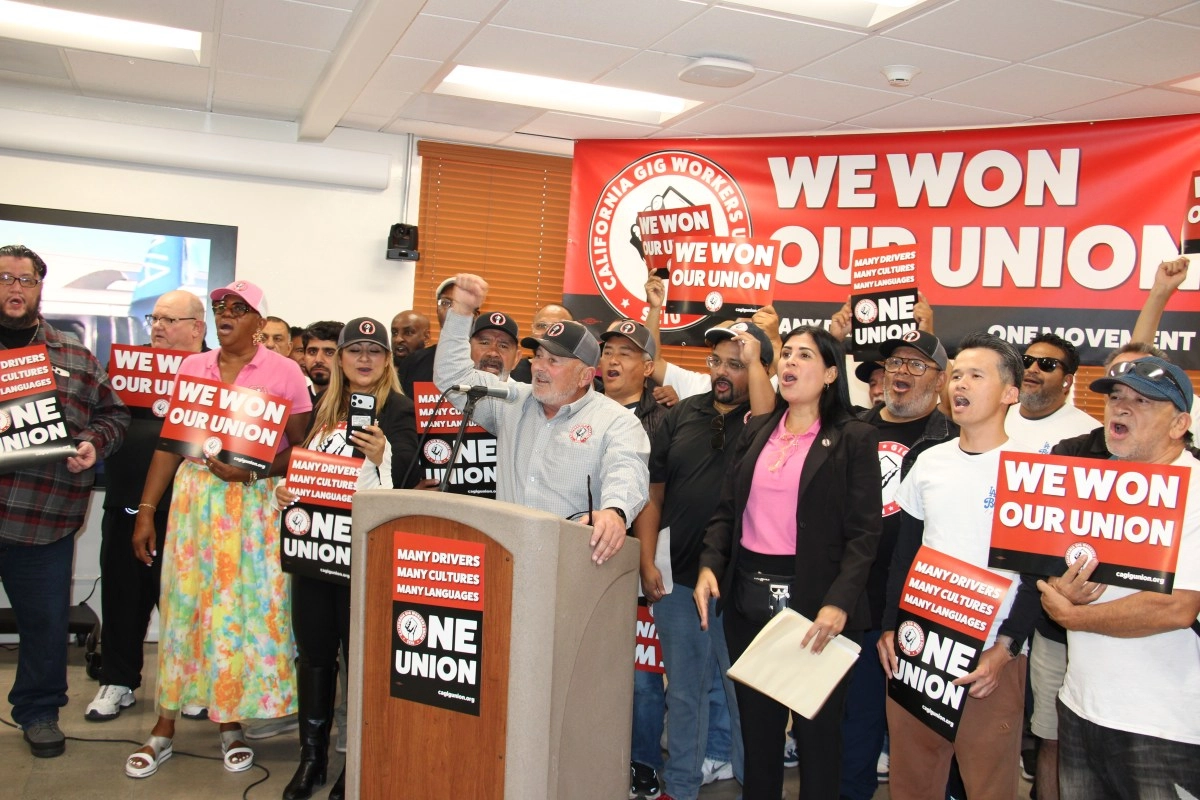

After more than ten years of fighting to get recognized as a union and be able to fight collectively for better pay and benefits, including health insurance, around 60, 000 Californian Uber and Lyft individuals won a historic victory.
Different of the digital platform economy ( Gig economy ) and of various cultures and languages, including English, Spanish, Mandarin, Hindi, and Punjabi, raised their fists in triumph.
Marvin Meléndez, a vehicle from Nicaragua, told La Opinión," I have worked for Uber and Lyft for eight years. I used to work four to six hours per day, making between 400 and 500 money, but now I only make between 250 and 300 dollars per day and want to put in more than 12 days.
Melenez noted that without receiving any payment, maintenance and gas prices have increased tremendously.
I hope a new deal did raise my and my coworkers ' salaries, giving me more time to work less and devote more time to my family and other tasks," he said.
The platform economy driver organizing success in California currently has the potential to be the biggest fresh worker organizing victory in current labor history.
Significantly underdeveloped
According to David Green, president and CEO of SEIU 721, Uber and Lyft drivers are among the most abused individuals in the United States.
He said," An unfairness against one is an injustice against all," adding that it is unheard of that the multimillion-dollar corporations in the industry "want to reduce the income and labor rights of these individuals to become richer, while the employees become poorer. "
The win for California's flat drivers comes in response to a growing push for union rights in the industry. Governor of Illinois last month These drivers have the right to organize, according to B. Pritzker, while Massachusetts voters recently approved a measure that grants them social negotiations rights.
Early this year, the Massachusetts flat drivers union received certification, joining a growing wave of SEIU organizing work among these employees all over the nation. In the United States, there are more than 2 million SEIU people.
David Green told La Opinión," I wish I could tell you that this marks the end of abuse, but we know that it continues to exist everywhere. " That these employees have a message at the table and fight for a great deal, one that includes the value we just mentioned, has been one more step in the direction of justice.
Uber and Lyft drivers won thanks to AB 1340, which was signed into law by Governor Gavin Newsom and constitutionally guarantees the right of all these workers to voice their opinions at the desk, something that Proposition 22 prevented them from doing.
A driver who preferred privacy claimed that" that fatal law [Proposition 22, passed in 2020] was a scam by Uber, Lyft, and Doordash for citizens. Although we were never considered normal people because we were classified as independent contractors, this prevented employers from providing us with traditional employment benefits, like unemployment insurance.
In fact, Uber and Lyft spent more than$ 200 million to pass Proposition 22 that promised better pay and benefits for employees in November 2020. That wasn't the case.
strewn, but united
Software drivers are geographically dispersed throughout California, do not have a typical work environment, or have established work schedules, and are therefore extremely challenging to organize the workforce.
However, drivers built a powerful movement across the state and overcame barriers to demand a voice in their work and win the right to collective bargaining.
Vikaas Shanker, a ride-hailing driver for Uber and Lyft in Fresno and a member and leader of the platform economy workers union, recalled that before joining this union fight, he thought the problems he faced were his alone.
However, he realized that Uber and Lyft's compensation systems isolated and separated drivers from each other.
"As we talked with drivers across the state, encouraging them to sign their union authorization card, I realized I was not alone in my struggles. Thousands of these conversations led to our victory – an unprecedented effort, led by the drivers themselves, that will soon become the largest ride-hailing drivers union on the planet."
In the last 10 months, their work was carried out from airport waiting areas, in cafes and car washes, digitally through social networks, video calls, text messages and phone calls, as well as through home visits.
These conversations gave rise to driving leaders—like Vikar—who worked to mobilize and motivate more of their peers, breaking down the isolating barriers imposed by the apps and building collective union power.
In fact, drivers organized through the unions SEIU 521, SEIU 721 and SEIU 1021 created the California Gig Workers Union (CGWU), fighting for meaningful participation in issues of wages, benefits and working conditions, in addition to challenging Proposition 22 both at the ballot box and in litigation that reached the California Supreme Court.
Thanks to driver advocacy, AB 1340 was passed last year, establishing a legal framework for California ride-hailing drivers to form a union and bargain collectively with ride-hailing companies.
On August 7, the Public Employment Relations Board (PERB) notified the CGWU that it had met the threshold necessary to represent drivers at the state level.
After a 30-day waiting period, the CGWU is expected to be certified as a collective bargaining representative for Uber and Lyft drivers in California.
“We built this movement because drivers on digital platforms talked to each other,” said Margarita Peñalosa, an Uber and Lyft driver based in Los Angeles. “We overcame fear and the hundreds of millions of dollars that companies in the sector spent to undermine our rights at the ballot box; we demonstrated that it is not the apps that connect us, but our common demand to be fairly compensated and treated with dignity as workers in the platform economy.”
The California Gig Workers Union (CGWU) is the collective voice of thousands of app drivers across the state, including those who work for companies like Uber and Lyft. After a decade of organizing with the unions SEIU 521, SEIU 721 and SEIU 1021, these drivers have fought to expand labor protections and guarantee the right to collective bargaining.
In 2025, the CGWU managed to establish a legal path for ride-hailing drivers in California to unionize and negotiate, at the state level, for better wages, benefits and working conditions.
“With a new contract I expect a better salary and benefits like any other worker,” said Manuel Díaz, a 31-year-old Peruvian driver and father of a daughter, who previously earned between 2,000 and 2,500 dollars every two weeks, but now he doesn't even make it to a thousand.”
For his part, Nolberto Cruz, originally from Puerto Cortés, Honduras, denounced that the Uber and Lyft platforms “are taking 82% of what consumers pay,” but he decided to continue working with both companies because they allowed him to do other jobs.
This news has been tken from authentic news syndicates and agencies and only the wordings has been changed keeping the menaing intact. We have not done personal research yet and do not guarantee the complete genuinity and request you to verify from other sources too.