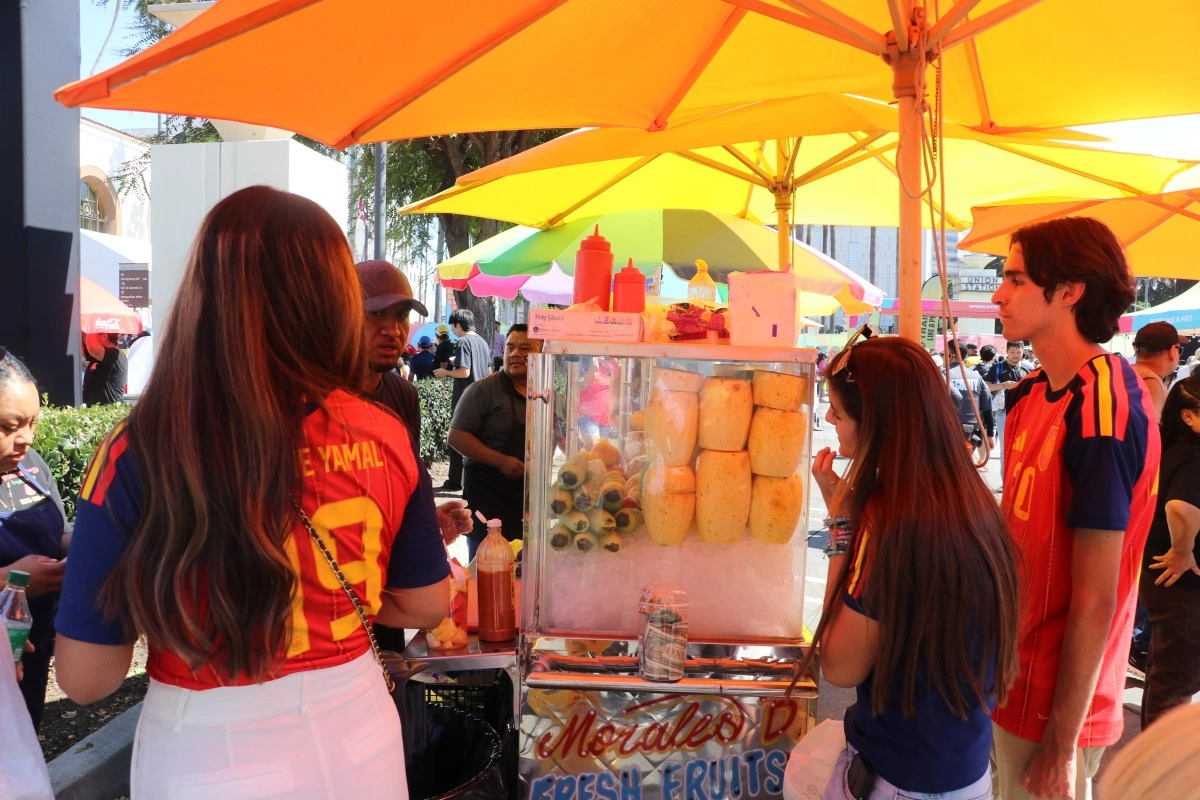

Many street vendors were sad and upset that their sales did not multiply during the match between the Uruguayan and Spanish teams, as they had to be located outside the fenced area of ​​the Los Angeles Fan Zone, in Union Station.
In addition to the fact that there were almost no Uruguayan fans and only a few dozen Spaniards attended the Soccer World Cup event, the street vendors did not carry the shirts or flags of both nations in their repertoire.
“I only have shirts from Brazil, Mexico and Argentina,” said Sabina Fonseca, a seller from Nayarit, Mexico. “Sales are very slow.”
Stationed on the corner of Main Street and César Chávez Avenue, from there she could not move anywhere else, since access to Placita Olvera was blocked by cyclone mesh. The Heritage Festival, organized by El Pueblo de Los Ángeles, would take place there at night.
At his side, Esaú González, from Guatemala, looked disconsolate.
“It's not very hot, so people aren't buying fresh water,” he said.
In his business he offered pineapple, horchata, orange, Jamaica, strawberry and cucumber waters with lemon.
“It's like this Cup isn't going to go very well for us,” he complained.
Except for the vendors who have permission to have their stalls at the Fan Fest, most of the street vendors are oblivious to the World Cup euphoria.
One of them was Miriam Morales, owner of “Morales Fresh Fruits,” who announced that she had to pay for insurance and have a health permit.
The immigrants' objective of making sales that would allow them to secure a substantial income to make ends meet with family expenses and cover pressing needs was frustrated in some cases, as was the Uruguayan team, which was eliminated from the competition.
“If I do well, I can get between $400 and $500,” said Horacio Aguilar, a hot-dog seller from Puebla. “My wife [Angélica González] and I have to raise money to help my daughter with her studies, but if things go badly, I will only get about $75.00.”
Horacio, 51, recognizes that the best buyers are his fellow Mexicans.
"We are soccer fans; win, lose or draw, Mexico eats," he says. "We, if we win, we piste [drink] and if we lose, we also piste. It is the culture that prevails in Mexico."
It is estimated that between 10,000 and 50,000 street vendors operate on the streets of Los Angeles. The range varies because official and community reports count formal food vendors differently compared to the total number of informal merchants (such as those who operate in commercial areas such as alleys or The Santee Alley.
On the same Main Street, in Placita Olvera, walking from one side to the other to catch the customers, Margarito Celedón, with an open shout, announces the sale of cornets.
"Young man, buy me one! They're cheap!" he says. “Two for $7.00 or one for $5.00.”
After eight hours of work, Celedón, originally from Oaxaca, says it went “well.” In total he pocketed $60.00.
“But, imagine, when I ran out of the two dozen cornets I went to dinner and that's where I lost $20.00 and another $5.00 from coffee,” he does the math. "And, well, I didn't even have time to buy a Mexico national team shirt. They are very expensive."
Even so, Margarito does not give up. He assures that he will save “a few cents” to buy a dozen Tri shirts, and plans to put them on sale at the next game in Mexico.
“Here, in the alleys of Los Angeles, a dozen is $200.00 and I could give them for $20.00 or $25,” he says.
The fruit stand of Evelyn García, from Guatemala, looks practically empty of customers.
“Like the glass?” asks Anthony Gil, a welder who came from Texas to do a job in Los Angeles.
“$10.00,” responded Evelyn, who makes the sales with her husband, Tony Cox.
Among the fans, Russians Egon Ushkov and Viktoria Babanina, who supported the Spanish team, commented that they loved the tacos.
“They were delicious and not expensive,” they said.
The one who did complain about the prices was Mrs. Gloria Ruiz, originally from San Salvador.
“I bought two pupusas for $7.00 each and as a Salvadoran, they did not honor our national food,” she said.
David Gallardo, a native of Madrid who arrived in Los Angeles, visited the food spots of Smorgasburg LA's selection of food trucks, which will offer an eclectic sample of Los Angeles from Friday to Sunday, including crowd favorites such as 8E8 Thai Food, Chubby Corn, College Boy Cheesesteaks, Dear Neighbor Handrolls, Vchos Pupusa Truck, Waku Food and more.
“In the end I decided to eat some tacos,” said Gallardo, one of the most fervent fans who enjoyed the victory of the “Red Fury.”
Fan Zone a Union Station
The Los Angeles Fan Zone, where thousands of World Cup fans gathered, was guarded by agents from a private agency, foot and mounted police, Los Angeles County sheriffs and Department of Homeland Security (DHS) officials.
The Los Angeles transportation agency continued to suggest football fans use public transportation to get to Union Station to avoid traffic jams in the downtown area.
“It's more convenient and economical since parking is limited,” said LA Metro spokesperson Mey Lyn Mitteenn. A round-trip ticket from anywhere in the city costs $3.50.
Additionally, Metro is transporting thousands of people from 15 stations. To learn more visit https://www.metro.net/.