
Imagine it's like arriving at a dinner party just as the hosts are in the middle of a tense discussion.
Football fans traveling to North America for the continent's first jointly organized World Cup will encounter three host countries that have experienced a period of great tension.
The tournament – ​​which will take place across an extensive geography that encompasses 16 host cities and three countries – comes after a period of conflictive relations between its organizers: the United States, Canada and Mexico.
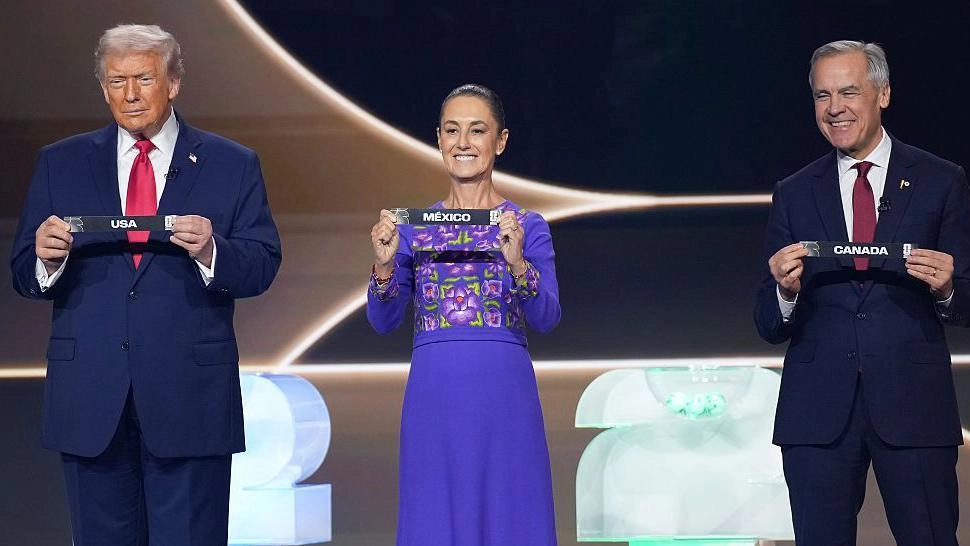
The underlying issues felt distant when the leaders of these countries gathered in Washington DC last December for the draw and posed for a selfie with FIFA president Gianni Infantino.
However, joining forces to host a full 39-day tournament will likely be a very different story.
The president of the United States, Donald Trump, has shamelessly stated that his country is the dominant power on the continent.
This means that very real tensions between the three nations on issues such as trade, immigration and drug trafficking—issues that have lain dormant since Trump took office—could once again rise to the surface.
On the other hand, if things are done right, the World Cup could forge closer ties between this trio of nations.
Tensions over trade, tourism… and Trump
Mexico and Canada, the US's main trading partners, will not have forgotten that they were among the first countries that Trump targeted with his tariffs.
Canada—a country that was also outraged by Trump's repeated comments about making it the “51st state” of the United States—responded with its own countermeasures.
Provinces pulled American alcoholic beverages from their shelves and Canadians significantly reduced their trips south, which, in turn, irritated the US.
The problems that both Canada and Mexico have with the US have also had an impact on the relationship between both countries, suggests Carlo Dade, director of international policy at the University of Calgary.
Many accused Canada of leaving Mexico in the lurch — or “throwing it under the bus” — on the eve of Trump's second term, as Canadian and U.S. officials said Mexico was serving as a “back door” into North America for Chinese investment.
“It was downright disrespectful,” Dade says.
This means that the Prime Minister of Canada, Mark Carney, has also found himself in the situation of having to rebuild relations with Mexico, while trying to diversify his trade to reduce dependence on the US.
Three is a crowd
Never before has a World Cup been held in three countries simultaneously.
And, since the 2026 tournament spans a continent, a wide range of different authorities will have to intervene.
With fans traveling between the three nations to attend games, the tightening of immigration control measures by the US could create logistical complications and exacerbate already tense tempers.
Likewise, U.S. security concerns—intensified by the ongoing war with Iran—could add new layers of frustration and increase the likelihood that seemingly harmless incidents will escalate unexpectedly.
“Cohosting these global sporting events is not necessarily a recipe for an idyllic relationship between hosts,” says Lindsay Sarah Krasnoff, author and associate clinical professor of global sport at New York University.
Krasnoff notes that while the 2023 Women's World Cup – hosted by New Zealand and Australia – turned out to be a decidedly positive outcome, the 2002 joint men's tournament between Japan and South Korea had a “bittersweet” outcome for two nations with a long and complex history.
“It did not have a negative impact on the bilateral relationship, but historically it is perceived, in a certain way, as a tie,” he adds.
FIFA itself has expressed high hopes for this model, stating: “It is a moment when three countries and an entire continent say in unison: 'We are united as one to welcome the world and deliver the biggest, best and most inclusive FIFA World Cup in history.'”
Putting patches?
The leader of each nation may want to use the tournament not only to show that they can maintain a good relationship with their neighbors, but also to teach a lesson to those who criticize them on internal issues.
This is undoubtedly true in the case of Mexico, where a certain pessimism has prevailed regarding the co-organization of the event.
Lingering questions have arisen about the readiness of the capital's main airport, its overcrowded public transport system and the renovated Azteca Stadium.
Not to mention the presence of cartel members in the streets a few months ago, in a brief but widespread demonstration of violence.
And now, the main teachers union is holding a nationwide strike to protest pensions and working conditions, accompanied by massive demonstrations that threaten to block the main access roads to the games.
Their motto is: “Without a solution (to their demands), there will be no kickoff.”
Yet despite all the challenges, Mexico's President Claudia Sheinbaum has remained resolutely optimistic.
“It is time to witness the best football in the world and to share with everyone who we are: not only a country of immense cultural heritage, but an empowered people,” he said last year.
It would be a mistake to hide the cracks or cover up the problems that Mexico has faced in the run-up to the start of the tournament, says Mexican sports journalist Rafael Puente.
“I really hope that the fans show patience and good behavior in the face of some of these problems that we cannot hide,” adds Puente.
“The only thing we can hope for is the excitement, enthusiasm and expectation that the Mexican people have shown in the past, particularly around the participation of the national team.”
A trio sets their goals beyond the tournament
Analysts suggest that the three neighboring countries could make further significant progress if they manage the situation properly over the next month.
The trio is immersed in a complex review process of a historic North American free trade agreement, known as USMCA.
This review has sown uncertainty over a commercial alliance that has been in force, in one form or another, since 1994.
Mexico has begun formal talks with the US, something Canada has not yet done.
Canada — which is seeking to strengthen its trade ties with China — and Mexico — which has increased tariffs on that Asian country — are also taking divergent courses with respect to the Trump administration's “elevating the importance of Beijing as a primary consideration,” says Dade of the University of Calgary.
However, the World Cup offers an opportunity for diplomacy, as we saw when Trump, Carney and Sheinbaum were smiling and united during the tournament draw in December.
“Anytime you bring leaders together, it's usually a positive thing,” Dade says.
For his part, Trump—who routinely boasts that his nation is the “hottest” nation in the world—clearly sees the World Cup as an opportunity for the U.S. to shine in the spotlight on the world stage.
Their eagerness to steal the spotlight—whether by attending events or posting on Truth Social—could create resentment between the two countries neighboring the US and ultimately damage long-term North American relations.
On the other hand, he has a strong personal interest in the success of the tournament, so he might take special pains to avoid the kind of diplomatic incidents that would mar the development of the event.
Football is a capricious game, as the cliché goes.
And just as sport itself is unpredictable, it is impossible to know what direction this new experiment in tripartite organization will take.
“From the first moment, it was clear that it was going to be something very complicated and complex,” says Krasnoff, “even from when the candidacy was initially awarded.”