
The idea of ​​the United States as “a country of immigrants” is going through a dark period on the eve of the 250th anniversary of the United States, while President Donald Trump's policies have led to the first migratory contraction of the population in more than half a century.
The country lost about 1.4 million immigrants in the first six months of the Trump Administration, from January to June 2025, according to the Pew Research Center, the first drop since the 1960s, when John F. Kennedy (1961-1963) was President, who popularized the phrase “a nation of immigrants.”
Daniel Mendoza, an American and grandson of Mexican immigrants, thinks the country “is treating its immigrants very badly,” which shows that “there has always been a fight, a battle, a war since the beginning of this country” over migrants.
"We are not in a very good place. I would love to be patriotic again. I would love to feel proud of the country," Mendoza, now part of the Democratic Socialists of America (DSA), tells EFE.
Activists warn of a setback in US immigration policy.
The United States has gone through other periods of strong rejection of immigration. In 1882 he passed a law banning Chinese immigration, and in 1924 he severely restricted the arrival of immigrants from Asia and other regions through a national quota system. At the end of the 19th century and the beginning of the 20th, Catholic immigrants, especially Irish and Italian, were also subject to discrimination.
Now, in 2026, Trump suspended immigrant visas from 75 countries, including Guatemala, Nicaragua, Brazil, Colombia, Cuba and Uruguay, after promising mass deportations and turning Immigration and Customs Enforcement (ICE) into the security agency with the largest budget in the US.
“This is a very dark moment in this history,” says María Bilbao, campaign coordinator for the American Friends Service Committee (AFSC) and migrant advocate.
“It seems disgusting to me how this country is behaving with immigrants, this Administration, and it seems to me that those of us who have the opportunity to speak have to do so, there has to be less apathy and people have to start talking about this,” he told EFE.
In addition, many Latinos, who represent more than half of the immigrants in the United States, 26.7 million of the total of 51.9 million, feel persecuted after the Supreme Court last September authorized agents in Los Angeles to detain people only based on their skin color and accent, which was carried over to other states.
"We do not want our local police to act like ICE agents. Please stop arresting, persecuting our communities and people, just because we look like Latinos or because we look like immigrants," Ana María Hernández, field director of the Florida Immigrant Coalition (FLIC), told EFE.
Migrant history persists
But activists point out the difficulty of excising migration from the history of the United States, where migrants still represent almost a fifth of the country's workforce and more than 15% of the total population, according to the Pew Research Center report, based on Census data.
In fact, Latinos alone contributed $4.4 trillion to the US economy in 2024, making them the fourth largest economy in the world, according to a report from the University of California, Los Angeles (UCLA).
For this reason, this July 4, activists consider it “critical to protect immigrant communities,” because that is “following the Constitution,” said Yareliz Mendez-Zamora, AFSC policy coordinator.
“While we are talking about independence, about freedom, it is important to know that this goes hand in hand with protecting our migrant communities,” he noted.
Many Americans, however, defend Kennedy's idea that the founding of the United States comes from immigrants who first settled in the colonies and their descendants, a phenomenon that has been repeated at different stages with various nationalities.
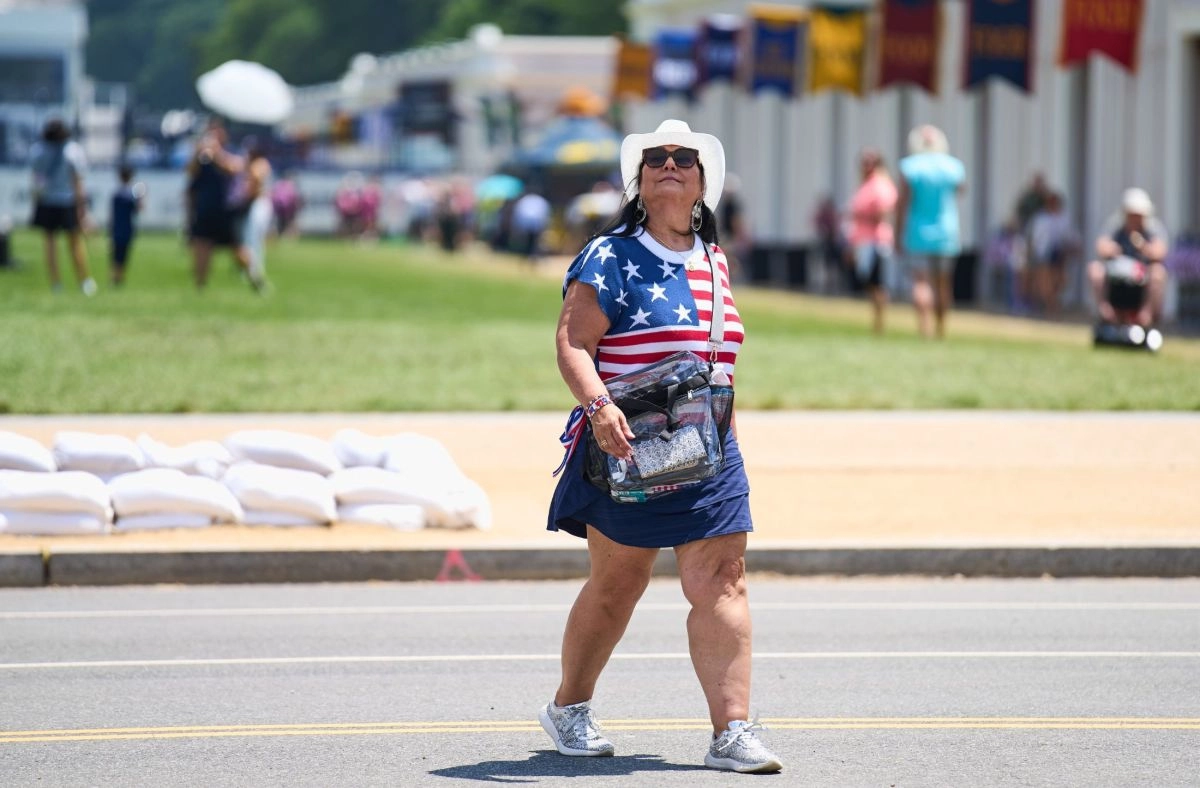
“When I come to protests and have the opportunity to raise this flag and remind people of it, and recover it from the hands of these people who in some way have corrupted the ideas of freedom and emancipation within the United States, that makes me feel American,” said Daniel Mendoza, son of Mexicans and born in this country.