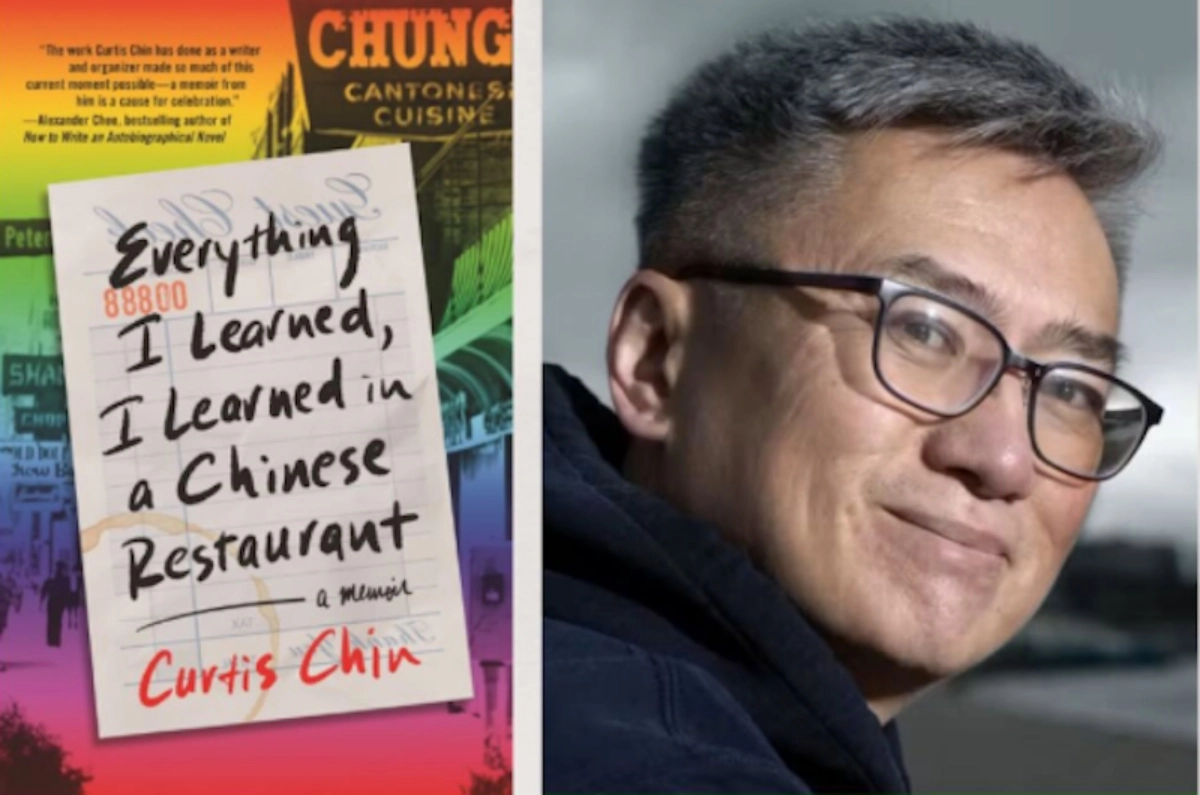

Fresh from a 10-country book tour for his book “Everything I Learned, I Learned in a Chinese Restaurant,” Curtis Chin said his memoir explores the question immigrants struggle with, whether to stay or leave.
Based on his own experience growing up as a Chinese-American in 1980s Detroit, Chin's family restaurant, Chung's Cantonese Cuisine, served as a rallying point for residents grappling with racial and economic tensions, as well as the first recorded hate crime the 1982 murder of Vincent Chin, who at age 27 was brutally beaten to death in Highland Park, Michigan.
“I personally knew five people murdered when I was 18, but despite that, we had this fabulous Chinese restaurant in the center of the city where my parents were able to raise me and my five siblings, and I had a wonderful childhood.”
At a special briefing hosted by American Community Media (ACoM) to commemorate Asian American and Pacific Islander (AAPI) Heritage Month, Chin said writing the book is a thank you to her parents but also a tribute to her hometown of Detroit, because she believes many people still misunderstand this city.
“The book is divided into three sections of eight stories each, because for many Chinese, 888 is good luck, so there are eight stories in elementary school, eight in middle school, eight in high school and eight in college.”
He explained that he began the prologue by talking about his family's trip to the Midwest in the 19th century because he doesn't believe you can know a person's history unless you know their family's history.
"Welcome to Chung's. Is it takeout? Armed with a smile and a red waiter's jacket with a perpetual stain of plum sauce, this was how my father greeted any new face who walked into the lobby of our popular Chinese restaurant in Detroit," Chin wrote in his book.
Curiously, he said, his great-great-grandfather Gong Li Chin faced the same question in the late 19th century, when he was alone and cold on a run-down dock in Guangzhou, China, trying to decide his future and that of his young, impoverished family: stay here or leave.
“Growing up, it was a question I asked myself, in the long, open back kitchen of our restaurant, where my family prepared some of our most popular dishes, including tasty barbecue pork and the best-smelling almond cookies.”
The prologue to his book follows the journey of Gong Li Chen and how he moved from Canton, China, to Canton, Ohio, before realizing that there were actually no Chinese there; and he went to Detroit where the automobile industry was just starting.”
He tried to get a job in one of the factories, but those early immigrants suffered a lot of discrimination, so he couldn't find work there, and so he accepted the only thing available: washing clothes by hand.
"He worked very, very hard, saved money and opened his own laundry. And the reason this fact is significant is because when the United States enacted the Chinese Exclusion Act, it was the first time that a certain population was prohibited from entering the country with two exceptions for students and business owners."
He said that since he owned his own business, he was able to sponsor the arrival of his son and, later, his grandson; and that is precisely why his family has a long history of immigration to the United States.
"They opened their first grocery store in the 1920s; in 1940 they opened Chung's Cantonese Cuisine, the restaurant where I grew up; this trajectory continued uninterrupted until the 1960s."
He said that back then, the United States was going through the struggle for civil rights, there was a lot more violence; Entire cities, like Detroit, were burning in flames, people were being murdered in the streets, and it was necessary to mobilize the National Guard to quell the violence.
"As a result, the entire city of Detroit was shut down for five consecutive days. My parents had to find something to do during that time. And what did my parents do? They had sex and nine months later, I was born: their 'riot baby.'
He noted that people always ask him why he talks so much about social justice, and he responds that he wrote a book because without that incident, he probably wouldn't be here.
“The book is a humorous and light-hearted look at growing up in one of America's great cities, Detroit, during a pivotal time—not only in the city's history, but in the history of the United States as well.”
He said that if we think about many of the problems we are going through today, many of the seeds were sown and put into motion precisely back then.
“That is why I think this book is extremely timely at the current moment, since it addresses many issues related to racial identity and coexistence between different communities.”
He said that his favorite quote in the entire book talks about the experience of immigration, and I approach it from the perspective of a moment when his family was in the cemetery celebrating Ching Ming (Grave Sweeping Day), a very traditional Chinese holiday, while we talked about our ancestors.
It was when he thought that his family prospered because of America, but America also prospered because of his family.
"To me, that sums it up. The reality is that immigrants come to this country and contribute enormously to its wealth. People claim that they come simply to take advantage, but nothing could be further from the truth, because the United States would not be the United States and the success it has achieved would not be at the same level if it were not for the arrival of immigrants."
Where to find the book?
What can other communities, particularly the Latino or Hispanic community, learn from this work?
It is nothing more than the story of a family working together in a family business, trying to help each other and dealing with the difficulties that surround them. I've had so many people come up to me, including a lot of Latinos, to say things like, Oh, my family owns a Mexican restaurant! It's exactly the same as my own experience!
That's why I think that, in that sense, history has a universal aspect; and it's actually very much about what it means to find your place in the world.
Hence that opening phrase: Is it time to go? It is a recurring theme in the book and something that, as you know, immigrants who leave their country to come to the United States often deal with, although, in reality, it is something that we all face. There always comes a time in life when you ask yourself that idea: Is it time to go?
I feel that that was precisely the reflection I had in Detroit; because, as much as I loved being around my family and enjoying all that fantastic Chinese food.
I simply had to make a personal decision and accept that I needed to move on. And I think that's something that everyone has to deal with, especially immigrants who leave their home country to come to the United States; But, really, I think it happens to anyone: there always comes that moment in life when you ask yourself: Is it time to move on?