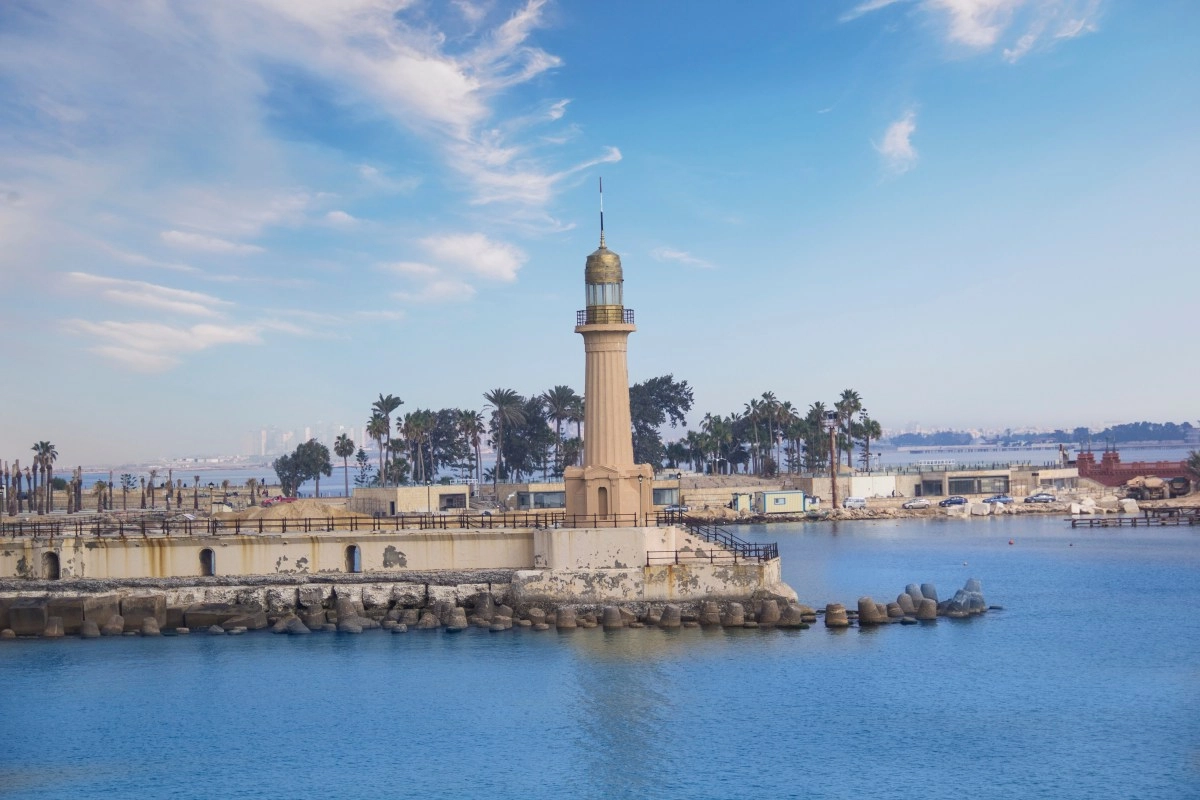

The Tower of Alexandria, one of the seven wonders of civilization, is the product of a global team of archaeologists ' discovery of 22 stones, which are part of one of the most famous constructions of civilization.
These pieces were submerged for decades off the coast of Egypt's coastline, particularly in the eastern port of Alexandria, at the bottom of the Mediterranean Sea.
The Dassault Systemes Foundation, the Egyptian Ministry of Tourism and Antiquities, and the French National Centre for Scientific Research ( CNRS ), led by archaeologist Isabelle Hairy, led the effort. This historic structure will now be documented, studied, and online recreated by them.
What precisely did they learn about Alexandria's Tower?
El Cronista lists slabs, jambs, thresholds, and paving tiles as some of the items that have been recovered from the bottom, with an estimated weight of between 70 and 80 000 kilos. These pieces were a part of the gigantic entry to the Lighthouse of Alexandria and show how the Greek period's architecture combines Greek and Egyptian customs.
More than 20 years ago, the historical job started. European scientist Jean-Yves Empereur led a large-scale inquiry in 1994 that found more than 3, 300 items, including sphinxes, orbs, columns, and gigantic granite blocks. The heaviest and most complicated bits, but, have remained submerged for the time being. Specialists were able to extract these gigantic pieces after almost 30 years of marine research and thanks to the use of cutting-edge technology, which are regarded as crucial for understanding the original structure of the lighthouse. They will now undergo extensive analysis to essentially realign the parts, similar to a gigantic jigsaw puzzle made of wood. The final objective is to make the tower accessible to both experts and the general public through a faithful digital reproduction.
The Castle of Alexandria's history and why it is regarded as a question of antiquity
At the start of the third century BC, during Ptolemy I Soter's rule, the Castle of Alexandria was constructed by the Greek engineer Sostratus of Cnidus. It soared more than 100 feet above the island of Pharos, serving a crucial purpose by guiding ships through Alexandria's difficult waters.
It was the tallest composition actually constructed by humans for more than 1,600 ages. Its drop started after a number of earthquakes, before a particularly severe one in 1303 made it unusable.
Under Sultan Al-Ashraf Sayf al-DinQa'it Bay's control, much of the jewel was reused to construct a fortress on the same site in 1477.It is still considered one of the seven wonders of antiquity today for a variety of reasons, including its engineering feat, functions, technological innovation, historical value, and especially its historic influence.
The other miracles of antiquity are, aside from the Castle of Alexandria,:
Additionally, another seven wonders of the world were chosen through a worldwide voting in the modern world in 2007. You probably have heard of some of them, but here they are: