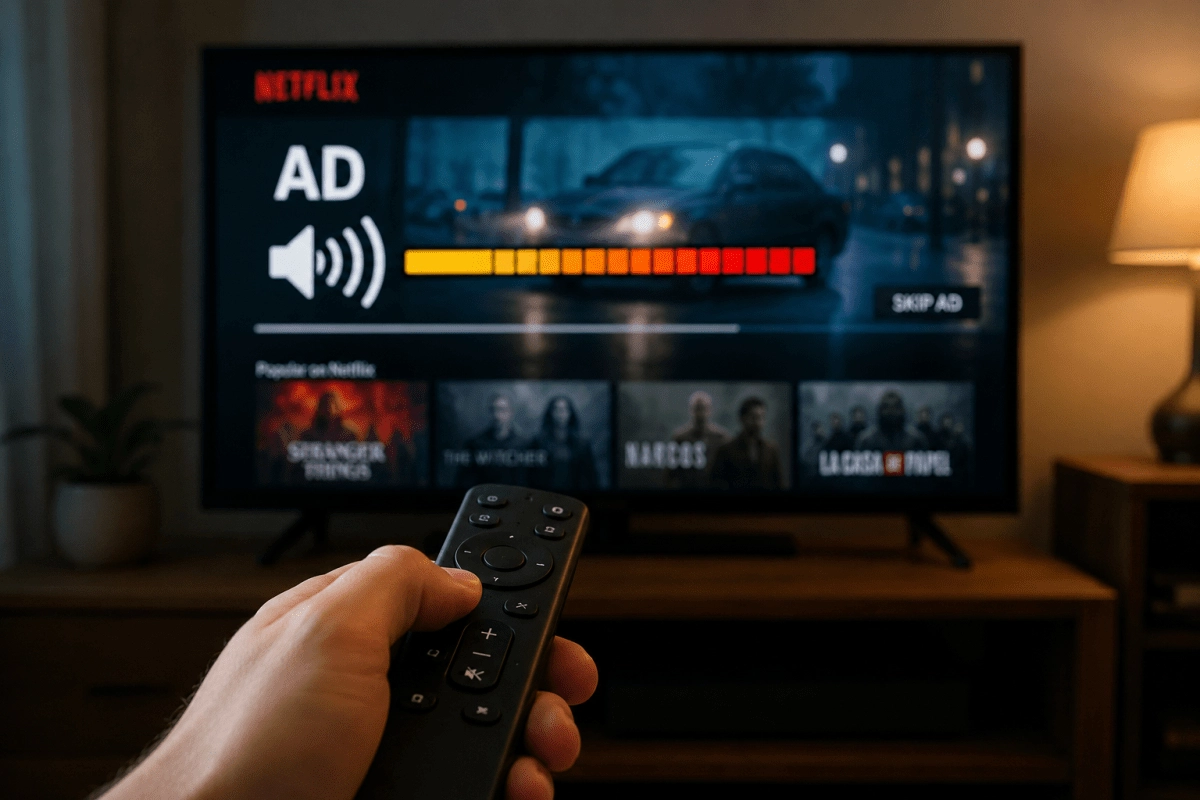

A new law prohibits commercials on streaming services from being louder than the series, movies or videos they interrupt. The measure is already in force and covers platforms that offer advertising-supported content to California residents.
The shocks caused by an advertisement that suddenly starts at a volume much louder than the movie or video being played should begin to disappear in California.
Since July 1, 2026, streaming platforms that provide services to consumers in the state are prohibited from broadcasting advertisements with a volume greater than the content they accompany. The measure covers services such as Netflix, YouTube, Hulu, Amazon Prime Video and other platforms that offer plans or content financed by advertising.
The rule is SB 576, signed by Governor Gavin Newsom on October 6, 2025. Its objective is to extend to streaming the restrictions that have been applied for years to commercials broadcast on open and cable television.
You can see: Did you get an urgent email from Netflix? It could be a trap
What changes for those who use Netflix, YouTube and other platforms
The law establishes that Internet video services may not transmit the audio of an advertisement at a level higher than that of the program, movie or video in which it appears.
This doesn't mean that commercials have to be silent or that platforms have to eliminate advertising. The obligation is to avoid the sudden jumps in volume that usually occur when an advertisement begins.
The regulation applies to companies that distribute content over the Internet and display commercial advertisements to California residents. It does not affect services that do not include advertising nor does it replace federal regulations that already apply to television channels and cable operators.
Why California passed this law
Newsom maintained when signing the rule that consumers do not want ads to be louder than the content they were watching. The initiative was introduced by state senator Thomas Umberg, who explained that it arose from the experience of a family whose baby was awakened by the sudden volume of commercials.
The problem was not new. In 2010, Congress passed the federal law known as the CALM Act, requiring television networks and cable providers to maintain similar volumes between programs and advertisements.
However, that legislation was passed before the massive growth of Netflix, YouTube and other digital platforms, so streaming services had been out of reach. SB 576 seeks to close that regulatory gap in California.
You can see: Best Netflix movies to watch in the United States this summer
Does the law only apply in California?
Formally, the obligation extends to platforms that offer content to consumers residing in California.
However, due to the size of the California market and the technical difficulty of applying different settings in each state, the measure could lead some companies to adjust the volume of their ads throughout the United States. For now, this possibility depends on the decisions made by each platform and is not a national obligation.
Illinois also passed similar restrictions on streaming ads, increasing pressure for companies to adopt a uniform standard.
What users can do if an ad is still too loud
The law does not create a private right for consumers to directly sue a platform over a noisy ad. The text itself clarifies that there is no individual judicial action derived from this rule.
The application of the measure corresponds to the state authorities. Users can also report the problem to the platform and record data such as the service used, the device, the program they were watching, and the ad in which the volume change occurred.
The rule represents a small, but perceptible change for millions of people who consume series, movies and videos through advertising-supported plans. In California, at least, cranking up the remote when a commercial comes on should slowly become a habit of the past.
You can see:
EA wants to fill its games with more advertising and that can change everything
Apple Music and Apple One increase in price: this you will pay from today
Arnold Schwarzenegger continues training at 78: what changed in his routine to not leave the gym