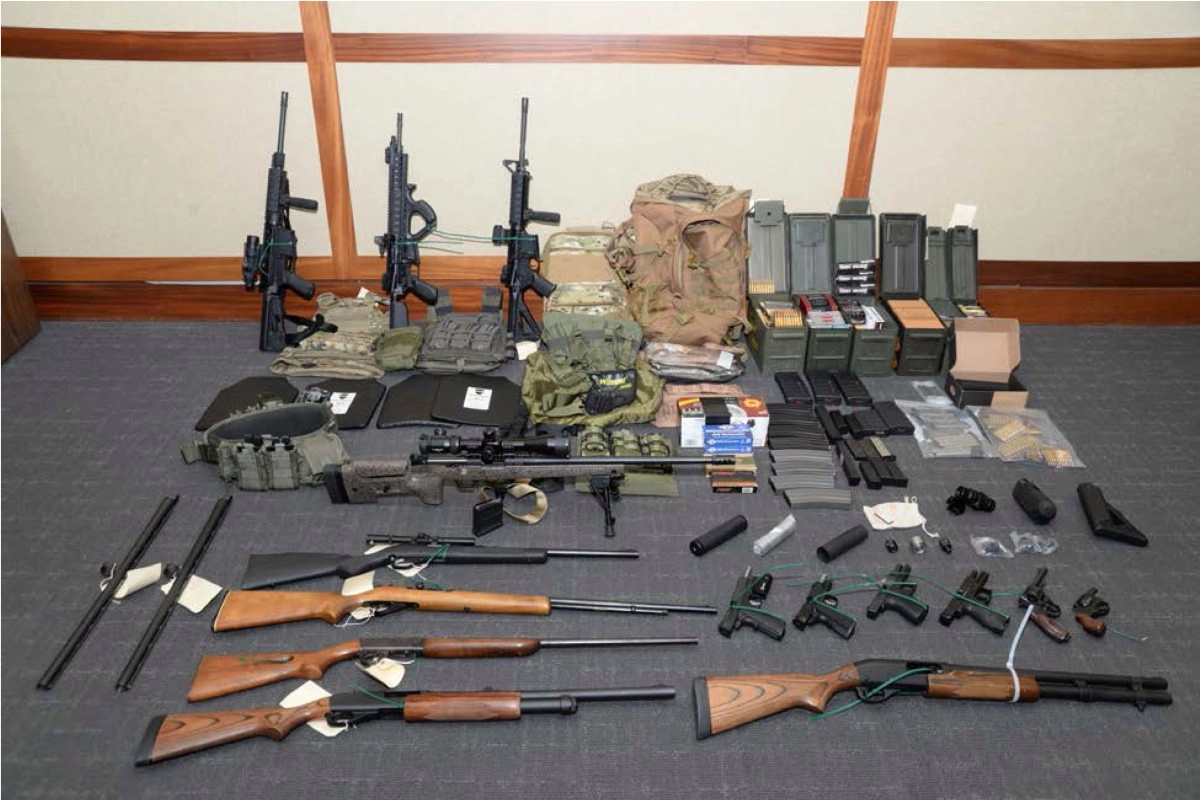

A federal judge in Texas issued a ruling that could transform the regulation of certain firearms and accessories in the United States by declaring unconstitutional several provisions of the National Firearms Act (NFA) related to silencers, short-barreled rifles, short-barreled shotguns and other weapons subject to a federal tax that was eliminated by Congress.
Judge James Wesley Hendrix, of the Northern District of Texas and appointed by President Donald Trump, held that Congress eliminated the constitutional basis of those regulations by reducing to zero the federal tax that for decades justified the registration, approval and documentation requirements provided for in the 1934 law.
In his resolution, Hendrix explained that the registration obligations were directly linked to the collection of that tax and that, when the tax disappeared, the legal basis that allowed these administrative requirements to be imposed also disappeared. “Therefore, the regulatory provisions must be declared unconstitutional because they exceed the enumerated powers of Congress,” the judge wrote.
However, the ruling does not have immediate national application. The order benefits only the plaintiffs in the consolidated cases and their members, clients, agencies and government subdivisions involved. Additionally, the judge suspended the decision from taking effect for seven days to allow the federal government to file an appeal.
The decision does not change all gun laws
The resolution also does not affect machine guns or other weapons regulated by the Gun Control Act, legislation based on Congress's authority to regulate interstate commerce and not exclusively on its tax power.
The litigation arose after Congress passed the so-called “One Big Beautiful Bill,” which eliminated the federal tax on the manufacture and transfer of silencers, short-barreled rifles, short-barreled shotguns and certain weapons classified as “Any Other Weapon” (AOW).
Until then, any transfer of these devices required an extensive procedure before the Bureau of Alcohol, Tobacco, Firearms and Explosives (ATF), including fingerprints, photographs, personal information and prior authorization from the federal agency.
The Justice Department defended the permanence of those provisions by arguing that they could stand under Congress's authority to regulate interstate commerce. However, Hendrix rejected that approach, considering that the NFA was created as a tax law and not as commercial legislation.
Advocacy groups celebrate; Gun control organizations question ruling
The decision was greeted with enthusiasm by organizations that promote the rights of gun owners and who participated in the lawsuit filed after the approval of the budget package known as “One Big Beautiful Bill.”
The plaintiffs include the Firearms Policy Coalition, manufacturers, distributors, private owners and 15 Republican-governed states: Texas, Alaska, Georgia, Idaho, Indiana, Kansas, Louisiana, Montana, North Dakota, Oklahoma, South Carolina, South Dakota, Utah, West Virginia and Wyoming.
Brandon Combs, president of the Firearms Policy Coalition, called the resolution a breakthrough for those seeking to eliminate the National Firearms Act entirely.
"This is a very important victory and a fundamental step forward in our strategic plan to end the National Firearms Act (NFA). We are eager to completely eliminate this unconstitutional system once and for all so that people can exercise their rights when, where and how they want," he said.
On the contrary, organizations that support greater gun controls warned that the decision could have consequences for public safety.
The Giffords Law Center argued that reducing controls on silencers and certain weapons would facilitate access to devices that it believes pose additional risks to law enforcement and the public. "Suppressors make it difficult for law enforcement to detect and locate active shooters. Additionally, short-barreled rifles and shotguns are easy to conceal and extremely dangerous," said Adam Skaggs, Giffords vice president.
The case could redefine the scope of federal regulation
Although the resolution represents a setback for the federal government, the case is still far from over. The decision was suspended for seven days and the Department of Justice has the possibility of appealing to the Fifth Circuit Court of Appeals, a court that in recent years has issued several rulings in favor of a broader interpretation of the Second Amendment.
In his 66-page opinion, Hendrix avoided ruling on arguments related to the constitutional right to bear arms. The judge explained that it was not necessary to resolve that issue because the plaintiffs had already prevailed by demonstrating, in their opinion, that Congress lost the constitutional authority to maintain those regulatory provisions once the tax that supported them was eliminated.
While the court process continues, current federal application, registration and approval requirements for NFA weapons remain in effect outside the specific scope of the court's order. The outcome of the appeal could define not only the future of this nearly century-old legislation, but also the limits of Congress's authority to regulate certain types of firearms in the United States.