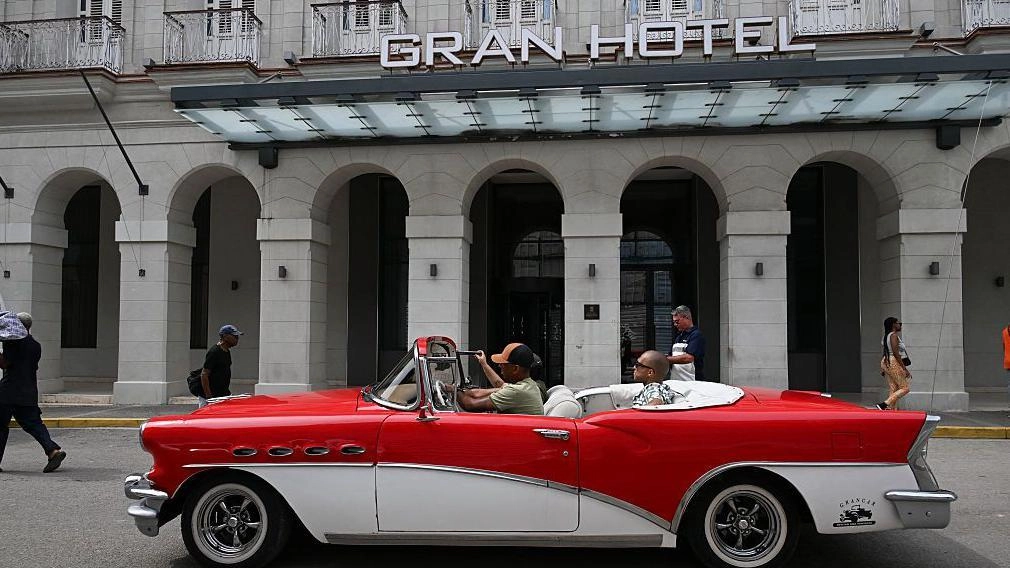

The partial withdrawal of the main foreign hotel chains represents a new setback for Cuba, which is going through one of the worst crises in its recent history.
The Spanish Meliá announced this Wednesday the immediate cessation of operations in 15 of its 34 hotels, specifically those linked to Gaviota, the tourist chain controlled by the Cuban military conglomerate Gaesa.
Shortly before, Iberostar gave up 12 of the 16 establishments it operated in Cuba, while the Canadian Blue Diamond reported that it was abandoning all its operations "with immediate effect."
They were joined by Archipelago International, the largest private hotel group in Southeast Asia, which withdrew its Aston brand from several hotels, including some of the most modern and luxurious in Havana.
The departure of these companies occurred after a new turn of the screw by Donald Trump's government on the Cuban economy.
On May 1, the US president signed an executive order that contemplates sanctions against people and companies that maintain economic ties with Gaesa.
The measure imposed an ultimatum for foreign companies to end their operations with the Cuban holding company before June 5.
Far from pointing the finger exclusively at the US, hotel companies have attributed the withdrawal to a combination of factors, from their legal concerns to the deterioration of operating conditions and the energy crisis that the island is experiencing.
His departure, in any case, further complicates the future of a sector considered key to earning foreign currency and, in extension, the survival of the Cuban economy.
How the Cuban tourism model works
Unlike what happens in many other tourist destinations, in Cuba hotels are usually owned by state companies such as Gaviota.
“The hotels continue to belong to Gaesa, but the administration is transferred through a contract to a foreign company,” economist Pavel Vidal explains to BBC Mundo.
Foreign chains provide the brand, reservation systems, international promotion, agreements with tour operators and much of the management and quality standards that until recently attracted millions of guests from Europe, Canada and other markets to Cuba.
“From that it is defined what participation it will have in the benefits that the hotel obtains,” points out, for his part, economist Ricardo Torres.
This is the main model, although there are also joint ventures between the Cuban State and foreign companies to develop, manage and operate tourist facilities.
A leasing model was also recently proposed in which the foreign company rents the facility and has greater operational autonomy.
The withdrawal of foreign chains does not mean that hotels will automatically close, since they may continue to be operated by Cuban state companies.
In any case, the question is not only who will manage these establishments, but who will be able to fill them.
In a country whose approximately 80,000 hotel rooms were largely managed by foreign operators, the loss of the commercial networks provided by Meliá, Iberostar, Blue Diamond or Archipelago could be a very hard blow.
The blow to an almost sunken sector
The departure of the main foreign hotel companies comes in the midst of a debacle in Cuba's tourism sector, which never managed to return to the levels prior to the 2020 pandemic, when between 4 and 5 million annual visitors used to arrive in the country.
Cuba received only 328,608 international tourists between January and April 2026, 55.8% less than in the same period of the previous year, according to data from the National Office of Statistics and Information (ONEI).
The decline accelerated especially starting in February as the energy and supply crisis affecting the island worsened, with daily blackouts lasting several hours and extreme fuel shortages.
This has affected key markets such as Canada and Spain—important sources of tourists—as a large part of the air routes to Cuba have been suspended due to airlines' difficulties in refueling at the island's airports.
Prolonged blackouts, energy shortages and the deterioration of basic services have also eroded the attractiveness of the destination, which recently offered empty beaches, semi-deserted hotels and few leisure options.
In this context, the economists consulted consider that the departure of Meliá, Iberostar, Blue Diamond and other chains represents a new blow to a sector that was already seriously weakened.
"The few visitors who could still go are now going to think twice. The foreign company always gave a certain quality guarantee to the operation of a hotel and now that guarantee disappears," says Ricardo Torres.
In the midst of the tourist debacle, the few hotel clients from now on could largely be residents of Cuba (from Cubans with income from abroad to foreign diplomats) or Cuban-Americans visiting their relatives.
Although the latter usually stay in private homes, they also usually vacation with their relatives in hotels in Varadero or one of the keys.
What it reveals about the Cuban economy
The new blow to tourism highlights the country's growing difficulty in maintaining ties with investors, suppliers and foreign companies in the midst of toughening US sanctions, which has applied a trade embargo to the island for more than six decades.
In fact, this Thursday the Cuban authorities announced that Visa and Mastercard electronic payments will be suspended as of June 6, citing the sanctions imposed by Washington.
Most of the hotel chains that have left Cuba operated establishments linked to Gaviota, the tourism arm of Gaesa, the opaque military conglomerate that dominates large areas of the Cuban economy.
Washington's new measures seek precisely to isolate this business group, forcing foreign companies to break relations with it or expose themselves to sanctions.
“This is leading not only hotel companies, but practically all that remained of foreign investment in Cuba—including suppliers, banks and shipping companies—to withdraw,” he says.
The economist goes further and maintains that the sanctions not only seek to pressure the Cuban government, but also displace Spanish and Canadian companies in the event of a possible change of regime or a profound transformation of the system.
“The way is being opened, leaving the economy available so that, in a negotiation with the United States, American capital can enter,” he believes.
Authorities from Washington and Havana have met in recent weeks to discuss issues related to the island's future, although the specific content of the conversations is unknown.
Vidal considers, however, that the offensive on Gaesa “may imply a reconfiguration of the geography of international capitals, in which Cuba will gradually insert itself,” he adds.
The departure of the multinational tourism companies also leaves the Cuban authorities facing a practical problem: what to do with a huge hotel network built during years of tourism expansion when the number of visitors has been reduced to a minimum.
One option, according to Ricardo Torres, would be to concentrate the few visitors in fewer facilities: “Why are you going to have so many hotels open if you don't have visitors?” he asks.
Another challenge is preserving the facilities, which have high fixed costs of maintenance, electricity and personnel, difficult for the Cuban State to assume.
“If this situation continues over time, the facilities will inevitably suffer, because the resources to maintain them are simply not there,” says Torres.