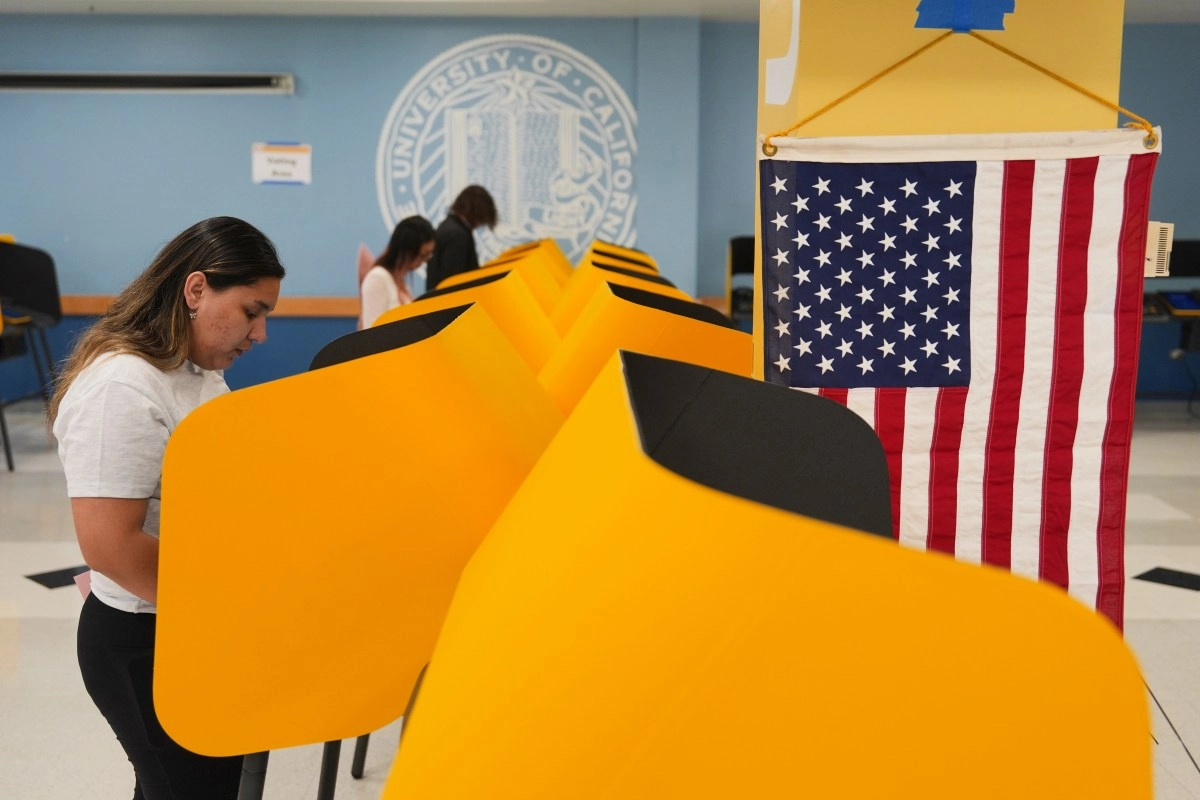

The state of California is emerging as the leading defender of voting rights, at a time when voting rights are being actively attacked at the federal level: in the courts, in Congress, through executive orders from President Donald Trump, and through the instrumentalization of the United States Department of Justice, an institution that historically was a bulwark against discrimination, but now represents a direct threat to voters of color.
With less than 100 days until the November general election, California gubernatorial candidate Xavier Becerra, state Senator Sabrina Cervantes (D/Riverside), voters and attorneys from the American Civil Liberties Union (ACLU) came together in Sacramento to push for the California Voting Rights Act of 2026, which includes bills SB 1360 and SB 1164.
"Democracy lives and breathes thanks to the vote. If Americans—if Californians—do not vote, democracy dies," declared Becerra, who supports the initiative.
SB 1164 aims to strengthen state-level protections against voter suppression, prevent vote dilution in local redistricting processes, and allow Californians to assert their voting rights directly in state courts.
SB 1360, also authored by Senator Sabrina Cervantes, focuses on the translation of election materials and expands language access and protections for voters with limited English proficiency.
“Unfortunately we have seen too often how malicious actors try to undermine, interfere with or block the vote, or tell [voters] that they should not participate in democracy,” Becerra stressed.
“Whether by undermining the Voting Rights Act — the federal law we are currently seeing challenged, including before the Supreme Court — or by political attacks from Washington D.C. through misleadingly named measures, such as the so-called “SAVE Act,” which would really only protect political parties that seek to prevent more and more Americans from voting,” Becerra added.
The so-called Safeguarding the Eligibility of American Voters (SAVE America) Act would require voters to present proof of their citizenship when registering and a photo ID when voting.
Opponents of Trump's wish consider that new barriers would be created for eligible voters.
Snub to Trump's wishes
As the Senate attempts to vote on various issues before recess, the SAVE America Act does not appear to be on the agenda.
According to a report from Axios, Louisiana Republican Senator John Kennedy stated on Wednesday that he does not believe the party leadership wants to prioritize the SAVE America Act.
Meanwhile, Senate Majority Leader John Thune of South Dakota is focusing on issues raised at the Senate Budget Committee hearing.
“Whether it be the attempt to illegally confiscate hundreds of thousands of ballots in California by law enforcement, trying to make people believe that there is fraud in our elections; or the current effort — which I believe originates outside of California, in Washington D.C., but which now directly affects us here through a ballot initiative, Proposition 39 — aimed at interfering with voting,” Becerra said.
Indeed, Chad Bianco, chief sheriff in Riverside County and former candidate for governor of California, gained national notoriety by launching an investigation into alleged electoral fraud after receiving complaints from an activist group.
The newly declassified court orders justifying the June investigation and confiscation of 650,000 ballots did not present direct evidence of voter fraud.
"We have to raise our voices," said Xavier Becerra, "We have to stand up because we understand that democracy lives or dies thanks to the vote. We want democracy to prosper; we must defend it and fight those who believe they can easily use their money to undermine the vote."
Likewise, in California there are Republican attempts to directly interfere in the elections through the proposal of Proposition 39.
“Both nationally and in California, we have witnessed ongoing efforts to make it more difficult for citizens to vote and undermine confidence in our elections,” said Julia A. Gomez, Senior Staff Attorney, ACLU of Southern California. "These attacks remind us that we should not take for granted the protections we have, because they were not easily achieved. Generations of African-American Americans led the fight, organizing, marching and making sacrifices in the face of racial segregation laws (Jim Crow) and a system designed to deny them power."
He noted that despite enormous barriers, voting rights pioneers built a movement that led to the passage of the federal Voting Rights Act of 1965, the crown jewel of the civil rights movement and the law that profoundly transformed American democracy.
“That same spirit of democratic expansion continued in California as visionary leaders worked to ensure that the promise of the Voting Rights Act reached more of the state's communities through the passage of the California Voting Rights Act of 2001,” he said.
The CVRA was signed into law in 2002 by former Democratic Governor Gray Davis. It was promoted by then-senator Richard Polanco and inspired by the vision of Joaquín G. Ávila, a key figure in the defense of the right to vote.
For her part, State Senator Sabrina Cervantes recalled that, under the leadership of Chief Justice John Roberts, the long-standing protections of the Federal Voting Rights Act of 1965 have been weakened.
I emphasize that a recent example was the court's decision in the case of Louisiana v. Callais, which has practically rendered said federal law null and void.
Decided on April 29, in Louisiana v. Callais, the United States Supreme Court ruled 6-3 that Louisiana's 2024 congressional district map—which incorporated a majority-Black second district—constituted unconstitutional racial gerrymandering; The Court held that Section 2 of the Voting Rights Act did not require the creation of such a district and that the measure lacked a compelling state interest.
“This means that many of the safeguards against vote dilution, voter suppression and electoral discrimination — measures that have protected Californians for generations — are no longer in effect in practice,” said the California legislator.
"We cannot afford to stand by while these protections are eroded. That is why we are taking action," Cervantes said.
Objectives of SB 1360 and SB 1164:
California Senate Bill 1360 (SB 1360), focuses on elections and the translation of election materials. The measure expands language access and protections for voters with limited English proficiency.
Key provisions
California Senate Bill 1164 (SB 1164) addresses voter suppression and vote dilution, updating protections at the state level to counter perceived rollbacks in voting rights at the federal level.
Key provisions
Ban Vote Suppression and Dilution: Strengthens state laws against discriminatory barriers to voting and against unfair district maps that weaken the electoral power of communities of color.
The two bills have been approved and are in the hands of the Assembly Appropriations Committee. They advanced in the legislative process at the beginning of July.