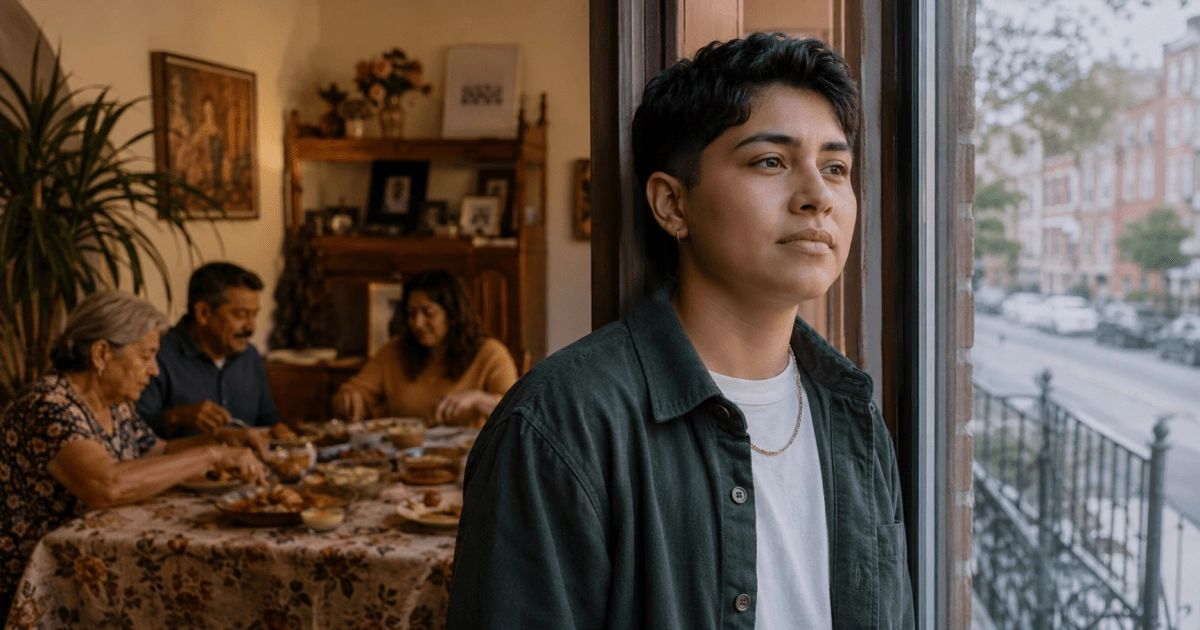

For millions of Hispanics in the United States, the word “diaspora” is not just an academic concept. It is an everyday experience. It is in the food that is prepared at home, in the language that is spoken - or that one tries to recover - in the music that plays at family parties, in calls with grandparents who live far away and in that sensation that is difficult to explain: belonging to more than one place and, sometimes, not feeling completely part of any of them.
The Latin diaspora is the community of people of Latin American origin who live outside their countries of origin, but maintain cultural, family, emotional or identity ties with those roots. In the United States, this reality affects millions of people: immigrants who arrived from Mexico, Cuba, the Dominican Republic, Colombia, Venezuela, El Salvador, Guatemala, Puerto Rico and other countries, but also children and grandchildren who were born in the United States and grew up between two worlds.
According to Pew Research Center, the Hispanic population in the United States reached 65.2 million people in July 2023, a new high, and represented more than 19% of the country's population.
That is to say: talking about the Latin diaspora is not talking about a small or marginal minority, but about one of the great cultural, demographic and social forces in the United States.
What does Latin diaspora mean?
The word diaspora is used to describe a community that disperses outside its territory of origin. It can occur due to economic migration, exile, conflicts, family reunification, search for opportunities or longer historical processes.
In the Latin case, the diaspora does not refer to a single country or a single history. The experience of a Mexican family in Los Angeles, of a Cuban in Miami, of a Dominican in New York, of a Salvadoran in Maryland or of a Venezuelan recently arrived in Texas is not the same. They can all be part of the Latin diaspora, but each one carries a different story.
That is why it is advisable to use the term carefully. “Latino” or “Hispanic” helps name a common experience, but it does not erase differences. The Latin world in the United States is made up of very different accents, foods, memories, social classes, skin tones, generations, immigration roles, and ties to the country of origin.
You can see: 10 Latin customs that Americans fall in love with
Living between two worlds: hybrid cultures
The phrase “living between two worlds” appears again and again when talking about children of immigrants. At home there can be a culture; outside, another. In the family, certain foods, songs, dates or ways of speaking are celebrated; At school, work or on the street, the rules may be different.
For some, that double belonging is a wealth. They grow up understanding more than one culture, they change languages ​​according to the context and learn to move in different codes. For others, it can be a source of tension: feeling “too Latino” in some spaces and “not Latino enough” in others.
That feeling becomes more visible in the second generation, that is, in those born in the United States with at least one immigrant parent. Pew Research Center estimated that in 2019, 36% of Hispanics in the U.S. were immigrants, 34% were second-generation, and 30% were third-generation or older.
There appears an intimate but very frequent question: where am I from if I was born in one country, but my family history begins in another?
Identity does not always fit on a label
One of the keys to understanding the Latin diaspora is that not everyone is named the same way. Some people identify as Hispanic or Latino. Others prefer to say Mexican, Cuban, Dominican, Salvadoran, Colombian or Venezuelan. Others feel simply American. Many use more than one identity at the same time.
Pew Research Center found that in its 2023 National Latino Survey, 52% of respondents most often described themselves by their family's country of origin, while 30% used panethnic terms such as Hispanic, Latino, Latinx or Latin, and 17% most often described themselves as American.
That data says a lot. For an important part of the community, identity does not begin in a broad category, but in a specific story: the Mexican grandmother, the Dominican father, the Cuban mother, the Puerto Rican neighborhood, Salvadoran food, Colombian music, childhood between two languages. The word “Latin” unites, but does not replace, those roots.
Language as a bridge and as a wound
Spanish occupies a central place in many Latino families in the United States, but it can also become a sensitive area. For some, speaking Spanish is a form of direct connection with parents, grandparents, and the country of origin. For others, not speaking it well can lead to shame, guilt, or the feeling of having lost a part of the family inheritance.
Pew Research Center notes that the majority of Latinos in the United States can carry on a conversation in Spanish, but also warns that not all are Spanish speakers and that about half of Latinos who do not speak Spanish have been shamed by other Latinos for not mastering the language.
This point is important because it shows real tension within the diaspora. Language unites, but it can also exclude. There are young Latinos who understand Spanish but respond in English. Others speak it with errors. Others are recovering it as adults. And others never learned it, but retain strong ties to their family culture.
Being part of the diaspora does not depend solely on speaking the language perfectly. It can also be in family memory, in rituals, in food, in surnames, in music, in the way of celebrating, in the relationship with parents and in the desire not to completely lose an inherited history.
The nostalgia that is also inherited
One of the most particular things about the diaspora is that nostalgia does not always belong only to those who emigrated. Sometimes children feel it too.
There are people born in the United States who miss a country where they never lived. They know him from family stories, summer vacations, meals, photos, calls, songs or stories repeated at the table. They do not have a complete memory of that place, but they do have an emotional relationship with it.
This inherited nostalgia can appear at very specific moments: when a grandparent dies, when you lose your language, when you visit your parents' country for the first time, when you listen to a familiar song or when you experience a World Cup far from your homeland.
For many Hispanics, the family's country functions as a symbolic second homeland. It is not always an idealized or easy place. Sometimes there is also pain, distance or conflict. But it is still part of the question of identity.
The diaspora also transforms the United States
Talking about the Latin diaspora is not just talking about what migrants conserve. It is also talking about what they transform.
The Latino presence changed music, food, television, sports, commerce, politics, churches, schools and urban life in the United States. Cities like Miami, Los Angeles, New York, Houston, Chicago, Orlando, San Antonio or Phoenix are not understood in the same way without their Hispanic communities.
That influence does not come from a single culture, but from many. The Latin diaspora is not homogeneous. It has salsa, regional Mexican, reggaeton, bachata, cumbia, mariachi, arepas, pupusas, tacos, mate, Cuban coffee, soccer, baseball, national holidays and very different ways of living with family and community.
At that intersection, the United States also changes. The diaspora is not a frozen community looking towards the country of origin. It is a living culture, which mixes, adapts, invents and creates new ways of being Latino in the United States.
Why many feel “neither from here nor from there”
The expression “neither from here nor from there” summarizes a common, although not universal, experience. It can be felt in the pressure to “integrate” into the United States without losing one's roots, or in the judgment of those who question whether someone is “Latin enough” because of their accent, their language, or their customs.
A child of immigrants can feel American because he or she was born, studied, and works in the United States. But you may also feel deeply connected to Mexico, Cuba, Colombia, the Dominican Republic, El Salvador, Venezuela, Guatemala, Puerto Rico or another place because of your family history.
Tension appears when these identities are presented as if they were incompatible. In reality, for millions of Hispanics, it is not about choosing just one. You can be American and Latino. You can speak English and maintain Spanish. You can love the country where you live and maintain a strong bond with the country of your parents. The diaspora lives precisely in that double belonging.