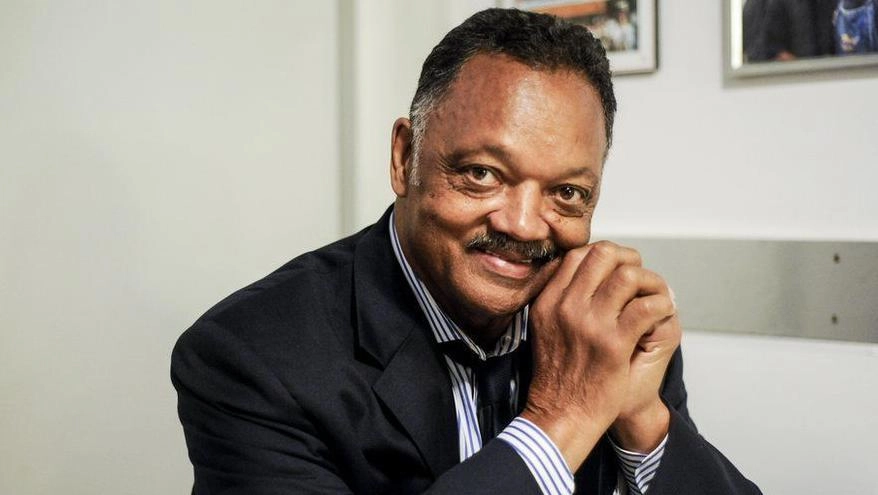

Jesse Jackson, a key figure during the civil rights movement in the United States in the 1960s and the first African American to run for president of the country with a major party, died this Tuesday at the age of 84.
Jackson “passed away” peacefully "I passed away Tuesday morning, surrounded by his family," his family said in a statement. "His unwavering commitment to justice, equality, and human rights helped propel a global movement for freedom and dignity," the family said. The cause of Jesse Jackson's political death has not yet been confirmed, but he was hospitalized in November and doctors said he had been diagnosed with a degenerative disease called progressive supranuclear palsy. A protege of Martin Luther King Jr., Jackson built his career around organizing and improving the lives of African Americans, becoming a national force During his two campaigns for the White House. While other African Americans had run for president, Jackson was the first to achieve significant electoral success, paving the way for those who followed, including Barack Obama and Kamala Harris. Throughout his career, Jackson created a movement to unite the population. 2024 in tribute to Jackson.
“This movement was not just about uniting us, but uniting us around a progressive program,” the Vermont senator added.
Jackson, a brilliant orator, expressed the frustrations of those who felt like second-class citizens in the most prosperous democracy in the world.
His speech at the 1988 Democratic National Convention, which ended with the slogan “keep hope alive,” would be repeated decades later in the slogan “hope and change” of Obama's successful 2008 presidential campaign.
Following his historic career in presidential campaigns,Jackson went on to position himself as a veteran statesman within the Democratic Party.
However, Jackson's final years would be marked by scandal, including revelations of marital infidelity and financial improprieties involving his son and political heir, Jesse Jackson Jr., who served as a congressman from Illinois.
In 2017, the elderly Jackson was diagnosed with Parkinson's disease and largely retired from public life. Later, that diagnosis was changed to progressive supranuclear palsy, a degenerative brain disease with similar symptoms.
Protege of Martin Luther King
Jackson was born Jesse Louis Burns on October 8, 1941, in Greenville, South Carolina, the son of 16-year-old Helen Burns. A single mother, she was expelled from her local Baptist church after becoming pregnant from an affair with a 33-year-old married neighbor, Noah Robinson.
When Jackson was two years old, his mother married Charles Jackson, who adopted his new stepson. Jesse Jackson remained in contact with Robinson and considered both men his fathers.
Charles Jackson was a religious man, and his son was raised in the church, a traditional center of Black political resistance since the era of slavery in the United States.
Growing up in South Carolina, Jackson, like all African Americans, was segregated from his white neighbors. He was forced to attend segregated schools and was only allowed in designated areas in public places, such as buses or restaurants.
In high school, Jackson earned good grades, was elected class representative, and excelled in almost every team sport.
A football scholarship to the University of Illinois helped Jackson pursue his ambitions and escape his impoverished surroundings. But he soon transferred from the predominantly white institution to a historically Black university in North Carolina.
He said he left Illinois because his white coaches wouldn't let him play quarterback in football, although that version is disputed. Records show the team already had a Black quarterback and that Jackson was on academic probation.
As a student at North Carolina A&T University, Jackson gradually became involved in the civil rights movement.
In 1960, he was arrested along with seven other students after a silent protest at a whites-only public library, which led to the desegregation of the library.
Four years later, Jackson graduated and moved to Chicago, where he trained to become a religious leader and caught the attention of King, the nation's most famous civil rights leader.
Through the Southern Christian Leadership Conference, founded by King in 1957 to promote nonviolent action in pursuit of social and economic justice, he established “Operation Breadbasket.”
The operation encouraged Black men and women to frequent businesses that offered them basic treatment and job opportunities, and to boycott those that did not.
Still in his twenties, Jackson was first asked to lead the Chicago branch of the operation and, soon after, to assume national leadership.
In 1968, Jackson's life changed dramatically.
He was meeting with his mentor at the Lorraine Motel in Memphis, Tennessee, when King was assassinated. Moments before the fatal shot, King leaned over the railing to chat cheerfully with Jackson, who was standing in the parking lot below. Jackson told reporters that he had killed King's head as he died, although other witnesses did not corroborate this account. The next day, Jackson controversially appeared on television with his clothes still stained with King's blood, assuming leadership of the civil rights movement. years before his death, began to speak of America's problems as being rooted in both class inequality and racism. The main divide, he said, was between the haves and the have-nots. “When we turn the race problem into a class struggle,” he told The New York Times, “then we'll have a new game.” Three years later, leadership disputes led to the split of Operation Breadbasket, and Jackson went on to form Operation PUSH (People United to Serve Humanity), a new, broad civil rights group. In the following years, Jackson became one of the most influential political figures in the United States. His organization, PUSH, championed education in underprivileged neighborhoods and affirmative action programs that allowed companies to hire Black workers. Presidential Candidacies, however, remained a controversial figure, with accusations that he had occasionally made antisemitic remarks and that, as an ordained minister and the product of an unplanned pregnancy, he opposed abortion.
The issue shook American politics after the historic Supreme Court ruling in the case “Roe v. Wade.” Democrats, who traditionally aligned themselves with the civil rights movement, mostly supported the legality of abortion.
“Human beings cannot give or create life on their own; it is truly a gift from God,” he wrote in 1977. “Therefore, no one has the right to take away what they have no capacity to give.”
With the unemployment rate among young Black people hovering around 50 percent, Jackson then announced his candidacy for president.
His decision caused pain among some of his natural supporters, including King's widow, Coretta, who feared he would not secure the Democratic Party nomination and would hurt the chances of other progressives. candidates.
During the campaign, Jackson spoke of the “rainbow coalition,” a broad group of voters of diverse races and beliefs who had traditionally been disadvantaged and who, according to Jackson, had been harmed by the policies of then-President Ronald Reagan, a Republican.
“Our flag is red, white, and blue, but our nation is a rainbow—red, yellow, brown, black, and white—and we are all precious in the eyes of God,” he declared in a speech at the 1984 Democratic National Convention, in which he called for party unification. Although Jackson ultimately lost the Democratic nomination, his campaign became a political and cultural phenomenon. In October 1984, he hosted Saturday Night Live, a popular weekly comedy show on the television network.His presidential candidacy also had a profound effect on the Democrats.
By winning more than 3 million votes and finishing third in the primaries, he demonstrated that a Black candidate could garner nationwide support and possibly reach the White House.
At the same time, by running on a liberal platform, he brought many important issues to the left wing of the party to the forefront and gave them momentum, such as universal healthcare and reparations for the descendants of slaves.
Jackson had publicly declared himself a supporter of a Palestinian state and had called the Prime Minister of Israel a “terrorist.”
He had also pledged never to use nuclear weapons in the first place and to cut defense spending if elected president—positions that seemed impossible at the height of the Cold War.
Four years later He ran again for president and continued campaigning on a liberal platform that included raising taxes, the increase in public spending and universal, state-funded healthcare.
Once again, he achieved impressive results, placing himself in the lead ahead of Michael Dukakis, the eventual nominee, but lost again, this time after securing just under 7 million votes and 1,023 delegates at the Democratic National Convention.
Those delegates endorsed reforms to the party's primary process, which made it easier for insurgent candidates like Jackson to compete for the party's presidential nomination without the backing of the Democratic establishment.
Controversial Figure
In 1992, he decided not to run for a third presidential term and, despite his suspicions about Bill Clinton's centrist "Third Way" policies, he lent his support to the former governor of Arkansas.
When Clinton saw his threatened presidency after his affair with Monica Lewinsky, a White House intern, became public, he asked Jackson her to advise his family during the crisis. Jackson stated that, although Clinton had lied about their relationship, he did not deserve to be impeached for "serious crimes." Clinton had committed a “minor offense,” he said.
In 2001, Jackson was publicly called to account for his own affair when it was revealed that he had had a relationship with a member of his staff and fathered a child.
Jackson promised to take a leave of absence to “revitalize my spirit and reconnect with my family,” but the speed with which he returned to public life damaged his credibility with some clergy members across the United States.
He maintained a high media profile with television programs and humanitarian missions, which some critics characterized as self-promotion.
In March 2007, Jackson pledged his support for Barack Obama's campaign to become the first African American in the White House.
Relations between the two men were initially strained after Jackson criticized Obama for “speaking condescendingly to Black people.”
His remarks were picked up by a nearby microphone, and Jackson later apologized. later for his “rude and hurtful remarks.”
However, moments before Obama delivered his victory speech in Chicago the following November, a television camera focused on Jackson in the audience with tears streaming down his cheeks.
Many viewers suggested that Jackson's success in boosting Black turnout in previous presidential campaigns had helped secure Obama's victory.
He later endorsed the new president's decision to support same-sex marriage, comparing the situation to the earlier struggle against the country's laws prohibiting interracial marriage.
Although he remained a political force, he faced difficulties in his personal life.
In 2013, his eldest son, Jesse Jackson Jr., was convicted of using campaign funds to finance his personal lifestyle and was sentenced to 30 months in prison.
Five years later, Jackson was diagnosed with Parkinson's disease and had to step down as leader of Rainbow/PUSH, the organization resulting from the merger of his two previous groups.
Even so, after the death of George Floyd, an African American man, at the hands of police officers in 2020, Jackson traveled to Minneapolis to call for criminal charges to be filed against the officers.
He also spoke out in favor of withdrawing US troops from Afghanistan and raising the minimum wage.
In 2024, Jackson requested a presidential pardon for his son's conviction, but it was rejected by then-President Joe Biden. That year, the veteran activist also returned to the political arena he loved so much, making a rare appearance at the Democratic convention in Chicago, where the party officially nominated Kamala Harris for president. High-profile delegates paid tribute to a man who, they said, had done much to ensure a Black woman had a fair chance of reaching the White House.Harris subsequently lost the 2024 election to Donald Trump.
“We learned at his feet,” said Al Sharpton, a fellow veteran civil rights activist who had worked with Jackson on Operation Breadbasket decades earlier.
Pramila Jayapal, a congresswoman from Washington state, addressed him in her convention speech, saying: “For every elected official we will see on that stage, we are here because you paved the way for us.”