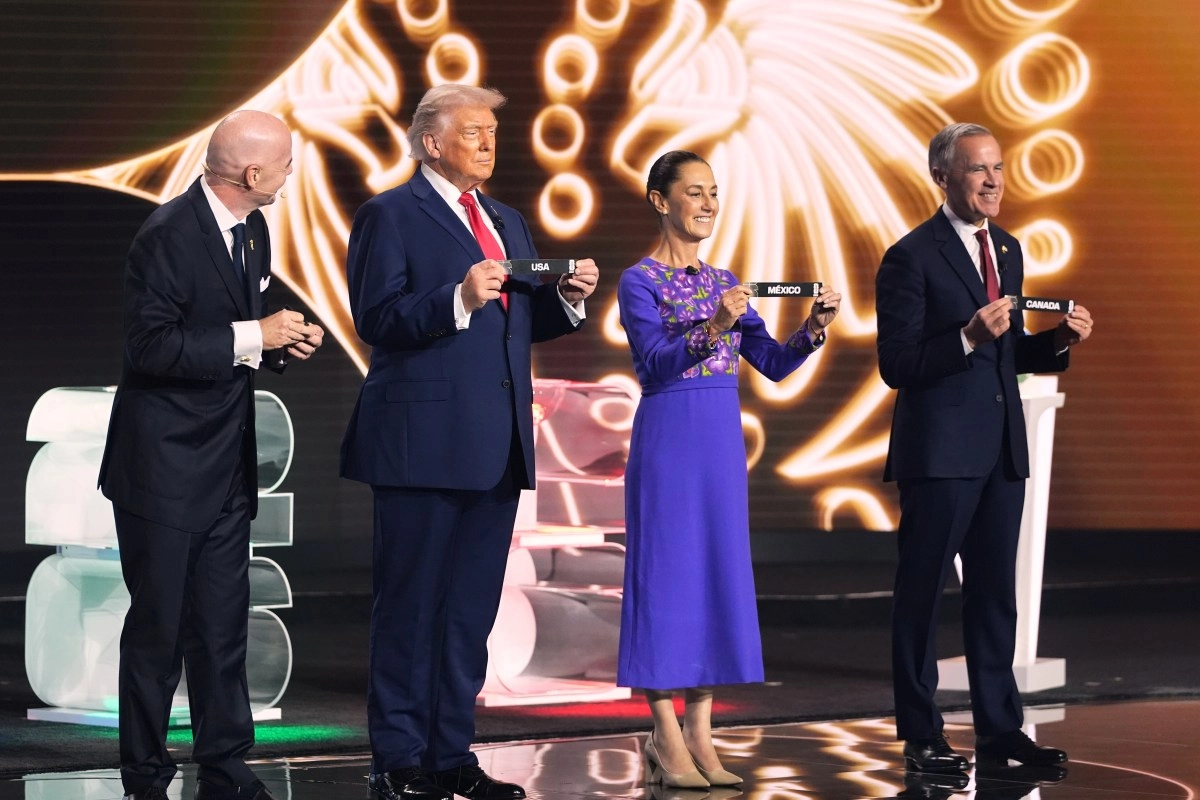

In a year-end interview with the Canadian public broadcaster CBC, Canadian Prime Minister Mark Carney asserted that the United States has "dozens" of demands on the table in its trade negotiations with Canada and Mexico, but that President Donald Trump has not formally suggested that he will abandon the United States-Mexico-Canada Agreement ( USMCA ), which will be broadcast in its entirety next Sunday. Carney said that his discussions with Trump "have revolved around reviewing and adjusting the USMCA, never about somebody abandoning it entirely" or about canceling it. He emphasized that Washington has always had this voice in mind. The meeting preview aims to ease local uncertainty prior to the crucial date of 2026, when the three nations must decide the treaty's future. The Canadian Prime Minister made note of the conversations Trump and the Mexican President, Claudia Sheinbaum, that included the exact stance. The three governments, in Carney's opinion, concur that the USMCA needs to be updated to reflect current socioeconomic challenges, but not to be broken. The three officials met in Washington on December 5 for discussions about the 2026 FIFA World Cup, which will be held simultaneously in the three nations. No specific agreements were reached at the time of the meeting, but it did allow for discussion on the convention review process and probable timelines. Before July 1, 2026, Mexico, the United States, and Canada must notify the USMCA that they wish to examine the deal or withdraw from it. After US Trade Representative Jamieson Greer's recent assertion that" all choices are on the table," confusion increased.
Washington's Needs and Canada's Red Lines
Carney made the revelation that Washington has made a long list of expectations during the diplomatic discussions. There are lots of troubles.
For instance, the US still has 54 concerns with Mexico, according to the Prime Minister during a press conference in Ottawa.
The American controlled dairy management system, which restates tariff-free exports and has been one of Trump's primary complaints, is one of the most sensitive points. Carney resolutely disagreed that Canada would not support reducing or reducing that plan. The Canadian prime minister also acknowledged that it is unlikely to be possible to reach fast sectoral agreements to lower the tariffs the Trump administration has imposed on goods like steel, aluminum, and power. In his opinion, all of these disagreements will eventually be incorporated into the USMCA's revision in 2026. Trump has repeatedly criticized the deal, even though it was negotiated during his first term, but Carney argued that there is no proof that the United States has abandoned it. He claimed that the debate is still about making changes and not leaving it on.
Recognition of Mexico
Carney also pointed out that the meetings Trump and Claudia Sheinbaum have. revolved around the same concept of? the three Northern American nations are a part of the USMCA, which is being updated and renewed.
He emphasized that the project is ongoing and covers both border surveillance and business. Mexico has been a key player in these discussions. It has taken cement and significant steps to address our fears to date, including:
• implementing legal and regulatory measures to address long-standing issues with intellectual property protection.
• modifying its foreign trade regulations to make it easier to correct operational mistakes without incurring penalties in customs statements
• Increasing the budget for its digital Single Window for Customs program, including reducing technical downtime. and addressing borders congestion issues,
• reducing the scope of the medical device regulation framework;
• harmonise the communications technology assessment requirements;
• Increase funding for labor and environmental standards, business law enforcement activities, and other priorities.
• Increase the prohibition against the import of forced labour into Mexico;
• Finalize a bill creating a system to assess international investments for threats to national protection.
• Improve Mexico's ability to halt illegal hunting in the Upper Gulf of California;
• Change Mexico's trade power laws to more closely resemble those in the US;
• introduces a bill that may raise tariffs on more than 1,400 items imported into Mexico from non-NAFTA nations, including China;
• Take steps to establish a new metal import tracking system.