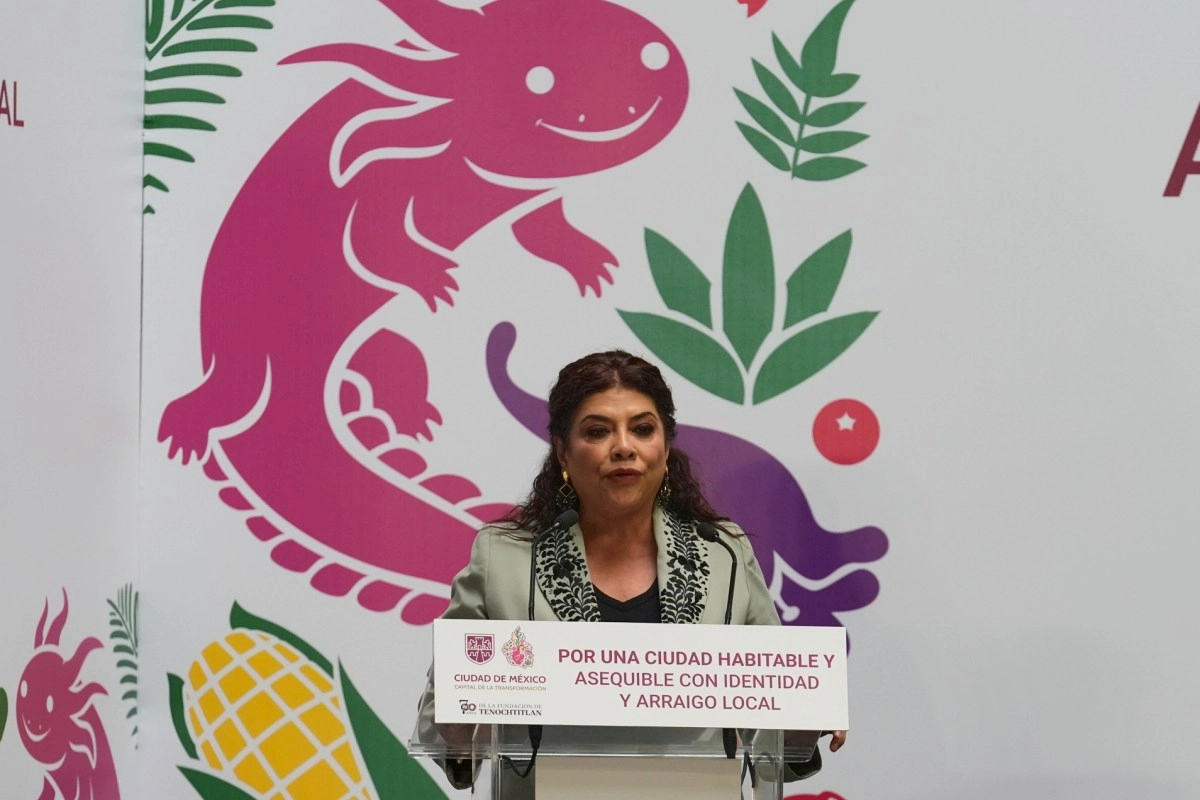

With an eye on June 11, the date the ball will roll in the opening match between Mexico and South Africa, the Head of Government of Mexico City (CDMX), Clara Brugada, made an ambitious promise: the Mexican capital will welcome the world as the safest city in its recent history.
Leading the meeting of the Third Committee of Mexico City for the 2026 FIFA World Cup to strengthen inter-institutional coordination and follow up on preparations, Clara Brugada Molina assured that the nation's capital is ready and prepared for the sporting event.
Mexico City is making steady progress towards the 2026 World Cup and is projected to be one of the safest venues for the tournament, assured Head of Government Clara Brugada, highlighting the sustained reduction in crime and the institutional coordination to receive millions of national and international visitors.
The nation's capital will host the opening match on June 11.
June 11, when the Mexican national team faces South Africa in a tournament that, for the first time, will feature 48 teams and will be jointly hosted by Mexico, the United States, and Canada. The grand final is scheduled for July 19. Brugada stated that the city is approaching 2026 with favorable security indicators. According to official figures, 2025 ended as the year with the fewest high-impact crimes since 2012. Compared to 2019, these crimes decreased by 56%, and compared to 2024, the decrease was 12%. The daily average dropped from 131 crimes in 2019 to 57 at the end of 2025.“We are entering 2026 prepared to host the World Cup as the safest city. The data proves it, and we are going to implement special strategies,” stated the mayor, emphasizing that the goal is to guarantee a peaceful city for both residents and visitors.
Security and Crime Reduction
Regarding high-impact crimes,Brugada highlighted that homicides decreased by 9% in 2025 compared to the previous year. Furthermore, femicides fell by 35%, from 68 cases in 2024 to 44 in 2025. According to the Head of Government, 42 of those cases were prosecuted, which, she said, brings the city closer to eradicating impunity for this crime. “We want a World Cup without homophobia, racism, or classism; a feminist and cosmopolitan city,” Brugada concluded. With 30,000 new surveillance cameras and 3,500 additional patrol cars, Mexico City is committed to ensuring that “fair play” begins on the streets. For his part, the Secretary of Government, Cesar Cravioto, agreed that 2025 was a year of significant progress in crime prevention and combating crime. She noted that the strategy will be strengthened in 2026 to further reduce crime and consolidate a safe environment during the World Cup.
Works, Mobility, and World Cup Experience
148 days before the start of the tournament, Brugada chaired the meeting of the Third Committee of Mexico City for the 2026 FIFA World Cup, where progress in infrastructure, mobility, and security was reviewed. The capital is developing more than 850 public works projects, which will exceed one thousand, with interventions in sports fields and community spaces.
Among the so-called “last-mile works” are improvements in neighborhoods near the Mexico City Stadium, rehabilitation of water wells, green infrastructure, pedestrian bridges, and urban regeneration projects in Santa Ursula.
In mobility, projects include the renovation of Metro Line 1, new trolleybus and Metrobus routes, as well as bike lanes and multimodal transfer centers.
In terms of security, 30,000 new cameras were installed, 3,500 patrol cars were added, and the Safe Routes program was expanded. In addition to the capital, Mexico will host matches in Monterrey and Guadalajara. In total, the country will host 13 matches, four of them in Mexico City, which seeks to consolidate itself not only as a football capital, but also as a safe, inclusive city, prepared for the world.She noted that the strategy will be strengthened in 2026 to further reduce crime and consolidate a safe environment during the World Cup.Works, Mobility, and World Cup Experience
148 days before the start of the tournament, Brugada chaired the meeting of the Third Committee of Mexico City for the 2026 FIFA World Cup, where progress in infrastructure, mobility, and security was reviewed. The capital is developing more than 850 public works projects, which will exceed one thousand, with interventions in sports fields and community spaces.
Among the so-called “last-mile works” are improvements in neighborhoods near the Mexico City Stadium, rehabilitation of water wells, green infrastructure, pedestrian bridges, and urban regeneration projects in Santa Ursula.
In mobility, projects include the renovation of Metro Line 1, new trolleybus and Metrobus routes, as well as bike lanes and multimodal transfer centers.
In terms of security, 30,000 new cameras were installed, 3,500 patrol cars were added, and the Safe Routes program was expanded. In addition to the capital, Mexico will host matches in Monterrey and Guadalajara. In total, the country will host 13 matches, four of them in Mexico City, which seeks to consolidate itself not only as a football capital, but also as a safe, inclusive city, prepared for the world.She noted that the strategy will be strengthened in 2026 to further reduce crime and consolidate a safe environment during the World Cup.Works, Mobility, and World Cup Experience
148 days before the start of the tournament, Brugada chaired the meeting of the Third Committee of Mexico City for the 2026 FIFA World Cup, where progress in infrastructure, mobility, and security was reviewed. The capital is developing more than 850 public works projects, which will exceed one thousand, with interventions in sports fields and community spaces.
Among the so-called “last-mile works” are improvements in neighborhoods near the Mexico City Stadium, rehabilitation of water wells, green infrastructure, pedestrian bridges, and urban regeneration projects in Santa Ursula.
In mobility, projects include the renovation of Metro Line 1, new trolleybus and Metrobus routes, as well as bike lanes and multimodal transfer centers.
In terms of security, 30,000 new cameras were installed, 3,500 patrol cars were added, and the Safe Routes program was expanded. In addition to the capital, Mexico will host matches in Monterrey and Guadalajara. In total, the country will host 13 matches, four of them in Mexico City, which seeks to consolidate itself not only as a football capital, but also as a safe, inclusive city, prepared for the world.