
During the war with Ukraine, the number of billionaires in Russia reached an all-time high.
However, in the 25 years that Vladimir Putin has been in power, the country's rich and powerful, known as oligarchs, have lost almost all of their influence politics.
Both are good news for the Russian president.
Western sanctions have failed to turn billionaires into opponents; on the contrary, their reward and punishment policies have transformed them into quiet allies.
Former banking billionaire Oleg Tinkov knows exactly how the punishments work.
The day after he criticized the war as “madness” in an Instagram post, his company's executives were contacted by the Kremlin. They were informed that their bank, Tinkoff, the second largest in Russia at the time, would be nationalized unless all ties with its founder were severed. “I couldn’t negotiate the price,” Tinkov told the New York Times. “I was a hostage: you just have to accept whatever they offer. I couldn’t negotiate.” Within a week, a company linked to Vladimir Potanin, currently Russia’s fifth richest businessman and a supplier of nickel for fighter jet engines, announced the purchase of the bank. According to Tinkov, it was sold for only 3% of its real value. In the end, Tinkov lost almost US$9 billion of his fortune and had to leave Russia. This is a far cry from how things were before Putin became president. In the years following the collapse of the Soviet Union, some Russians became enormously wealthy by taking over large, formerly state-owned companies and capitalizing on the opportunities of their country's burgeoning capitalism. Their newfound wealth gave them influence and power during a period of political upheaval, and they became known as oligarchs.
“I did not see in him the future greedy tyrant”
Russia’s most powerful oligarch, Boris Berezovsky, claimed to have orchestrated Putin’s rise to the presidency in 2000, and years later apologized for it:
“I did not see in him the future greedy and usurping tyrant, the man who would trample on freedom and stifle Russia’s development,” he wrote in 2012.
Berezovsky may have exaggerated his role, but Russian oligarchs were certainly capable of pulling the strings in the highest echelons of power.
Just over a year after his apology, Berezovsky was found dead under mysterious circumstances while in exile in the UK.
By then, the Russian oligarchy had also been completely destroyed.
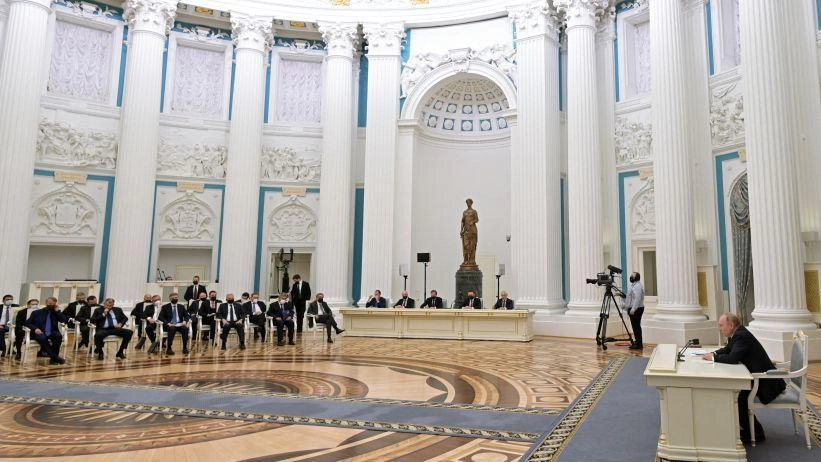
So when Putin gathered Russia’s richest men in the Kremlin, hours after ordering the invasion On February 24, 2022, they could do little to oppose the large-scale invasion of Ukraine, despite knowing their fortunes were about to take a severe blow. “I hope that, under these new conditions, we will work together just as well and as effectively,” he told them. A journalist present at the meeting described the assembled billionaires as “pale and depressed.” The preparations for the invasion were very bad for Russian billionaires, as were its immediate consequences. According to Forbes magazine, by April 2022, their number had fallen from 117 to 83 due to the war, sanctions, and the depreciation of the ruble. Collectively, they lost US$263 billion, or 27% of each individual's wealth on average.
But the following years showed that immense benefits could be gained by being part of Putin's war economy.
The massive war spending fueled economic growth of more than 4% annually in Russia in 2023 and 2024. This benefited even those ultra-wealthy Russians who didn't earn billions directly from defense contracts.
Supplying the military
In 2024, more than half of Russia's billionaires were involved in supplying the military or profiting from the invasion, says Giacomo Tognini of Forbes' Wealth team.
“That doesn't include those who aren't directly involved but need some kind of relationship with the Kremlin. And I think it's fair to say that anyone who runs a business in Russia "He needs to have a relationship with the government," he told the BBC. This year saw the highest number of billionaires in Russia on the Forbes list: 140. Their collective wealth—some US$580 billion—was just US$3 billion shy of the all-time high recorded the year before the invasion.
But while Putin allowed his loyalists to profit, he also systematically punished those who refused to follow the rules.
Russians vividly remember what happened to oil tycoon Mikhail Khodorkovsky.
After becoming Russia's richest man, he spent 10 years in prison after founding a pro-democracy organization in 2001.
Since the invasion, almost all of Russia's mega-rich have remained silent, and the few who have publicly opposed it have had to leave the country and much of their wealth.
Russia's richest men are clearly key to Putin's war effort, and many of them, including the 37 businessmen summoned to the Kremlin on February 24, 2022, have been subject to Western sanctions.
But if the West wanted to impoverish them and turn them against the Kremlin, it has failed, given their continued wealth and the absence of dissent among Russian billionaires.
If any of them had considered defecting to the West with their billions, the sanctions made it impossible.
“What the West did caused Russian billionaires to rally around the flag,” says Alexander Kolyandr of the Center for European Political Analysis (CEPA).
“There was absolutely no plan, no idea, no clear path for any of them to jump ship. Assets were sanctioned, accounts were frozen, properties were seized. All of that helped Putin mobilize the billionaires, their assets, and their money, and use it to support Russia’s war economy,” he tells the BBC.
The exodus of foreign companies after the invasion of Ukraine created a vacuum that was quickly filled by Kremlin-friendly businessmen, who were allowed to buy highly lucrative assets at bargain prices.
This created a new “army of loyal, influential, and “assets,” argues Alexandra Prokopenko of the Carnegie Russia Eurasia Center. “Their future well-being depends on the continued confrontation between Russia and the West,” while their greatest fear is the return of the previous owner, she states. In 2024 alone, 11 new billionaires emerged in Russia in this way, according to Giacomo Tognini. Putin has maintained a firm grip on the country’s top leaders, despite the war and Western sanctions (and in some respects because of them). Click here to read more stories from BBC News Mundo. Subscribe here to our new newsletter to receive a selection of our best content of the week every Friday. You can also follow us on YouTube, Instagram, TikTok, X, Facebook, and our new WhatsApp channel.
And remember that you can receive notifications in our app. Download the latest version and activate them.