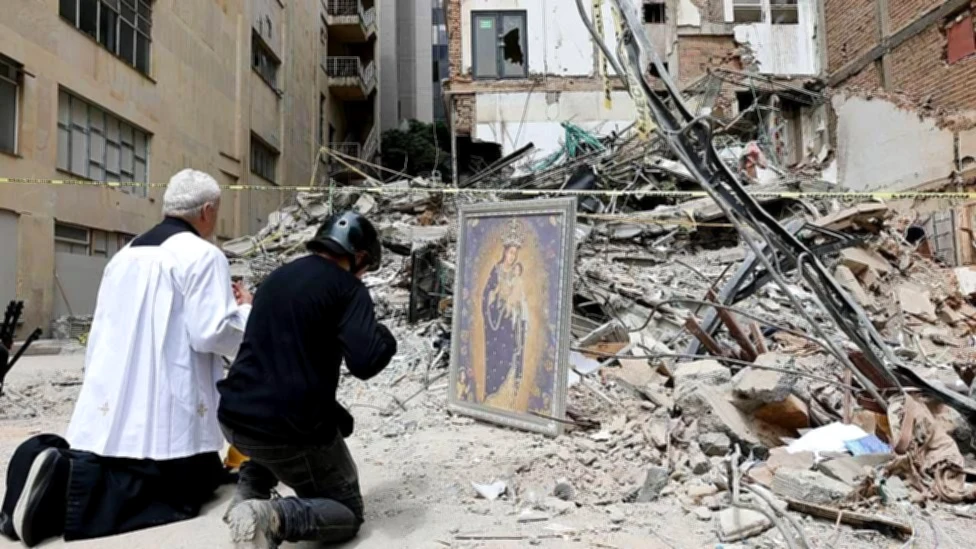

24 June, Venezuela. Colombia, August 10. 20 August, Peru.
In less than two weeks, three South American nations experienced powerful tremors of a magnitude greater than 7.
More than 6, 000 people died in northeastern Venezuela as a result of devastating tremors of scale 7. 2 and 7. 5 in June. More than 300 people died in the 7. 4-magnitude earthquake that occurred in Colombia's western in August. Additionally, the earthquake that struck Ayacucho in Peru on September 7, that left no survivors but injured.
Numerous users contacted BBC World with the same problem: Are those tremors related? Faced with the succession of geological activities?
There is no link between what we know and what we can respond, according to Rafael Abreu, a geophysicist at the USGS Earthquake Information Center.
If there is a connection between all of this seismicity, it is not a relationship that the model of medical knowledge at the time permits us to see.
The University of Concepción in Chile's Department of Geophysics, Ignacia Calisto, told BBC Mundo that" the disasters in Venezuela, Colombia, and Peru do not appear to be connected by a domino result. "
These events take place in tectonically quite active regions where there is permanent seismicity as a result of geological plate movement, he claimed.
Breu uses the metaphor of three parallel generation lines moving at different speeds.
Think that the product is an earthquake at the end of each generation range. What occurs is that eventually, at a specific moment, at the end of each series the item falls, either together or in a very short amount of time.
According to the authors, that is what occurred during those three disasters.
Colombia and Peru were not the only ones who experienced tremors in Venezuela, and the disasters in Venezuela were not the result of a past disaster.
These disasters occurred at the time they occurred because of seismic conditions in each industry, without one influencing the another.
Venezuela, Colombia, and Peru have distinct geological features.
The subsequent earthquakes in Venezuela occurred on the geological ratio between the Caribbean dish and the South American plate, occurring at a level close to 10 kilometers away from the surface.
On the other hand, the earthquakes in Colombia and Peru occurred at abyss of 110 and 99 miles, respectively, in the space between the Nazca disk and the South American dish.
The panels ' interactions even vary depending on the type.
The horizontal movement between the plates in Venezuela was referred to as" strike slip," which is what is known as in English.
The term" straight slip" refers to a vertical movement loss. You have two stone blocks. The Caribbean dish is only one wall. The South American dish is the other block. The panels are sliding side by side, each in the same way, according to Abreu.
The Nazca disk and the South American plate have what we refer to as a parallel margin, where two plates are colliding, in the case of Colombia and Peru.
You have the continental crust ( South American plate ), which has a composition of one type of rock, and you have the oceanic plate ( Nazca plate ), which has another type of rock composition.
What we refer to as collision in that phone is what we call it. When the sea plate collides, it begins to sink. The sea plate is thicker and heavier. Then the floor no longer has the contact between the two sheets, the margin. It is vertical, and this causes disasters all throughout this interaction.
According to Calisto, "recent tremors in Peru and Colombia occurred at abyss close to or above 100 kilometers, indicating that they did not occur in contact between the two plates but within the Nazca dish, which is already submerged beneath the globe. " These kinds of situations are referred to as intraplaque disasters.
The collision dish has now crossed the western cortex at 100 kilometers and is now submerged in the mantle. It cannot cause interplaque earthquakes, which would be like a panic, but instead fracture" by the inside" because it is no longer in direct touch with the other tray.
According to geophysics at the University of Concepción, these earthquakes are distinct from big tremors that occur in contact with plates ( such as those in Sumatra 2004, Maule 2010, and Tohoku 2011 ).
These latter can reach very big magnitudes, which can cause tsunamis when they occur beneath the ocean and cause vertical ground quakes.
In contrast, intraplate earthquakes are too heavy to directly cause a tsunami, and they typically have lower area intensity than an equal magnitude earthquake, which can be felt in very large areas.
Yes, there is a situation where one disaster" buds" another, and it is one of the replicas.
However, these occur in the immediate vicinity of the major disaster, both in terms of time and location.
The versions are smaller earthquakes that result from the major disaster, according to Abreu.
According to Calisto," the reproductions themselves are the result of big disasters, in a kind of reacomode of the rock that was fractured and slipped, so that its replicas are the result of an earthquake"?
Therefore, one might claim that an earthquake "kills" its versions, but it doesn't act as a concept as a trigger, but rather as a reaction.
The first of them may trigger the next seismic double, but these occur quite close both temporally and temporally.
The University of Concepción expert makes it clear that there is evidence that" after a large earthquake, in the limits of the ruptures can generate a permanent effort that can affect adjacent seismic segments, give more effort to an area that is already loaded and, consequently, affect the possibility of occurrence of an earthquake ( example: Sumatra 2004, 2005, 2007 and 2007; there were two earthquakes in 2007 )".
It's like the reacomode affects another portion, but because it's in another portion, it's a copy. " In that case, it's like the reacomode affects another section.
Another earthquakes have just left fear and deficits in Latin America, in addition to the ones in Venezuela, Colombia, and Peru.
According to data collected by the National Seismological Network ( RSN), two earthquakes of magnitude 5. 4 and 4. 8 shook the province of San José in Costa Rica on August 24 in just two minutes.
And on August 26, Colombia's record-keeping country experienced a fresh earthquake of magnitude 5. 1, which affected parts of the country's northern and north, including Bogotá.
However, according to Abreu, the recorded tectonic activity, which includes disasters greater than magnitude 7 in Venezuela, Colombia, and Peru, "is well within the yearly average of earthquakes" in quantitative terms.
According to Calisto, there have been two tremors of scale comparable to those in Venezuela, Colombia, and Peru on average over the past six years in South America.
Colombia and Peru are especially affected by the earthquake zone's high price of disasters, which are decreasing in magnitude as the magnitude rises.
In these situations, the type of earthquake ( intraplaca ) that occurs is less frequent than the earthquakes that occur in contact.
These disasters occur recurrently in Venezuela as a result of the panels ' vertical contact.
There has been a trend that is no more in the field of geology, but rather one of public perception, according to researchers consulted by BBC Mundo.
" We have had three events that have had major damage and had an impact on well-populated places," the statement goes. And all the interest that these events have received gives the impression that there is more tectonic activity, which is untrue, Abreu says.
According to Calisto," after every cultural catastrophe there will be an increase in interest in these topics. People are considering them more, especially in those places where it is known that an earthquake may arise.
As well as being organic people, public policies must be in line with both normal threats and the reduction of risk. ”
Abreu contends that the seismicity found in South America is no unusual despite what people think.
There have been many significant situations, but they have taken place in faraway places and have not had an impact on people.
People say," ah, wait," after these three disasters that have affected communities.
" But it is not that there is an increase in seismicity, nor that disasters that have occurred in one area are affecting or destabilizing people. "